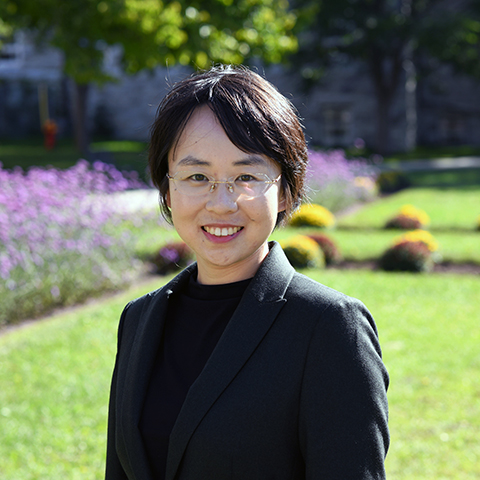
Xiaying Xin PhD, E.I.T., HKIE

Assistant Professor

Faculty, Civil Engineering
Phone: 613-533-6000 ext. 75197
Fax: 613-533-2128
Ellis Hall, Office: 247

Expertise: Emerging Microbial and Chemical Contaminants, Nanobubble Technology, EMCC removal and remediation, Environmental Chemistry and Toxicology
Xiaying Xin
Biography Research Teaching Publications Awards & Grants Open Positions

My research projects help to address the following UN Sustainable Development Goals:
  

 Learn more


Dr. Xiaying Xin is an Assistant Professor in the Department of Civil Engineering at Queen’s University, with a background in environmental science and engineering. Her research focuses on emerging contaminants, including per- and polyfluoroalkyl substances (PFAS), flame retardants, micro-/nano-plastics, pharmaceuticals and personal care products (PPCPs), cyanobacteria and cyanotoxins, and antibiotic resistance. She investigates their monitoring, fate and transport, toxicological impacts, and removal from water, wastewater, drinking water distribution system, and soil environments.

Dr. Xin is recognized as an emerging leader in the development of nanobubble technology for water and wastewater treatment, soil remediation, and invasive species control, contributing significantly to this innovative and growing field. Her research is highly interdisciplinary, bridging environmental and chemical engineering, environmental chemistry, analytical chemistry, and microbiology. She is committed to advancing cost-effective, energy-efficient, and climate-resilient treatment solutions to support communities in achieving the United Nations Sustainable Development Goals (UN SDGs).

Before joining Queen’s, Dr. Xin was a Research Assistant Professor at the State Key Laboratory of Marine Pollution and the School of Energy and Environment at the City University of Hong Kong (September 2021 – August 2022). She also worked as a Postdoctoral Fellow at Memorial University of Newfoundland (October 2019 – May 2021).

Dr. Xin earned her PhD in Environmental Systems Engineering from the University of Regina in Canada and holds a BSc in Environmental Science from Yangzhou University, China.


  • Emerging Microbial and Chemical Contaminants
  • Nanobubble Technology
  • Water and Wastewater Treatment, Drinking Water Distribution System Remediation, Soil Remediation
  • Invasive Species Removal
  • Environmental Chemistry and Toxicology


Instructor:

  • CIVL 210 Chemistry for Civil Engineers
  • CIVL 472 Water Treatment
  • CIVL 886 Advanced Water Treatment 
     

Co-Instructor (or Module Contributor):

  • CIVL 372 Water and Wastewater Engineering
  • APSC 135 Introductory Chemistry for Technology Students
  • CMAS801-Topics in Applied Sustainability


Please find my Google Scholar Page


Selected Publications

  • N. Fadaie, L. Vitkova, W. Wang; X. Xin; K. De France. Crosslinkable Protein Nanofiber Aerogels for the Removal of Cationic and Anionic Dyes. ACS Mater. Au. (2026).
  • W. Wang, X. Xin*, E. Criminisi. The role of gas composition in nanobubbles: Generation, characterization, applications, and future directions for sustainable technologies. J. Water Process Eng., 81, 109287. (2026).
  • P. Koutorjevski, A. Braga, X. Xin*, Q. Zhang, Simplified and semi-automated Microcystis aeruginosa cell enumeration method using brightfield microscopy. J. Environ. Eng., 152(5), 04026010 (2026).
  • Z. Zhao, Y. Zhao, W. Wang, X. Xin, Y. Jiao, A. Abell, C. Law, and A. Santos. Coupling of Engineered High Entropy Alloys with Semiconducting TiO2 Nanofilms for Scalable and Ultrafast Alkaline Hydrogen Evolution Reaction. Adv. Sci., e14558 (2025).
  • C. Wang, V. Thiagarajan, Y. Li, X. Xin, T. Nah. Sulfate radical-mediated oxidation of the microcystin-LR and microcystin-RR by UV/peroxydisulfate: Degradation kinetics, transformation products, reaction mechanisms, and toxicity. J. Water Process Eng., 77, 108583 (2025).
  • X. Huang, T. Li, X. Xin*, R.W.S. Lai, F. Li, K.M.Y. Leung. Innovative and Sustainable Strategies for Algal Bloom Mitigation and Water Quality Enhancement. Canadian Journal of Civil Engineering, accepted (2025).
  • T., Vignesh, T. Nah*, X. Xin*. Impacts of atmospheric particulate matter deposition on phytoplankton: A review. Science of the Total Environment, 175280 (2024).
  • J. Gu, X. Xin*, Q. Zhang, X. Wu. Exploring the Role of Airtightness for Achieving Carbon Neutrality in Canadian Residential Buildings: A Streamlined Life Cycle Assessment. Journal of Environmental Informatics Letters (2024).
  • C. Wat, X. Xin*, R. Lai, X. Mao, K. Leung. Impact of environmental factors changes induced by marine heatwaves and heavy precipitation on antibiotic toxicity to Isochrysis galbana: Implications for climate change adaptation. Marine Pollution Bulletin, 203, 116453 (2024).
  • Z. Qin, M. Siddiqui, X. Xin, J. Mou, S. Varjani, G. Chen, C. Lin. Identification of microplastics in raw and treated municipal solid waste landfill leachates in Hong Kong, China. Chemosphere, 351, 141208 (2024).
  • X. Xin, B. Chen, M. Yang, S. Gao, H. Wang, W. Gu, X. Li, and B. Zhang. A critical review on the interaction of polymer particles and co-existing contaminants: adsorption mechanism, exposure factors, effects on plankton species. Journal of Hazardous Materials, 130463 (2022).
  • X. Xin, B. Chen, B. Péquin, P. Songd, M. Yang, X. Song, B. Zhang, Binary Toxicity of Polystyrene Nanoplastics and Polybrominated Diphenyl Ethers to Arctic Cyanobacteria under Ambient and Future Climates. Water Research, 119188 (2022).
  • X. Xin, Literature Review on Membrane Biofouling Occurring in MBR and Its Related Technologies for Greywater or Wastewater Treatment. Journal of Environmental Informatics Letters, 7, 1 (2022).
  • Q. Kang, S. Xing, X. Xin (co-first author), B. Chen, Y. Chen, X. Ye, B. Zhang. Machine Learning¬¬–Aided Causal Inference Framework for Environmental Data Analysis: A COVID-19 Case Study. Environmental Science and Technology, 55,19 (2021): 13400-13410.
  • X. Xin, G. Huang, D. Halstead, K. Gaetz, L. Benmerrouche, J. Huang, Y. Wu, J. Zhang, N. Wang, Y. Fu. "The Optimization of Canola Crop Production through Wheat Residue Management within a Western Canadian Context—A Case Study of Saint-Front, Saskatchewan." Sustainability 13, 18 (2021): 10459.
  • X. Xin, G. Huang, B. Zhang, Y. Zhou. Trophic transfer potential of nTiO2, nZnO, and triclosan in an algae-algae eating fish food chain. Aquatic Toxicology, 235 (2021): 105824.
  • X. Xin, G. Huang, B. Zhang. Review of Aquatic Toxicity of Pharmaceuticals and Personal Care Products to Algae, Journal of Hazardous Materials, 410 (2021): 124619.
  • X. Xin, G. Huang, C. An. C. Lu. Exploring the biophysicochemical alteration of green alga Asterococcus superbus interactively affected by TiO2-P25, nano-ZnO, and triclosan and illumination, Journal of Hazardous Materials, 398 (2020): 122855.
  • X. Xin, G. Huang, C. An, & R. Feng. Interactive Toxicity of Triclosan and Nano-TiO2 to Green Alga Eremosphaera viridis in Lake Erie: A new perspective based on Fourier transform infrared spectromicroscopy and synchrotron-based X-ray fluorescence imaging. Environmental Science and Technology, 53, 16 (2019): 9884-9894.
  • X. Xin, G. Huang, C. An, H. Weger, G. Cheng, J. Shen, S. Rosendahl. Analyzing biochemical alteration of green algae during chronic exposure to triclosan based on synchrotron-based Fourier transform infrared spectromicroscopy. Analytical Chemistry, 91, 12 (2019): 7798-7806.
  • X. Xin, G. Huang, C. An, R. Raina-Fulton, and H. Weger, Insights into long-term toxicity of triclosan to freshwater green algae in Lake Erie, Environmental Science and Technology, 53, 4 (2019): 2189-2198.
  • X. Xin, G. Huang, C. An, C. Huang, H. Weger, S. Zhao, Y. Zhou, S. Rosendahl. Insights into the toxicity of triclosan to green microalga Chlorococcum sp. using synchrotron-based Fourier transform infrared spectromicroscopy: biophysiological analyses and roles of environmental factors. Environmental Science and Technology, 52, 4 (2018): 2295-2306.
  • X. Xin, G. Huang, X. Liu, C. An, Y. Yao, H. Weger, P. Zhang, and X. Chen. Molecular toxicity of triclosan and carbamazepine to green algae Chlorococcum sp.: a single cell view using synchrotron Fourier transform infrared spectromicroscopy. Environmental Pollution, 226 (2017): 12-20.
  • X. Xin, G. Huang, X. Zhou, W. Sun, C. Jin, W. Jiang, S. Zhao. Potential antifouling compounds with antidiatom adhesion activities from the sponge-associated bacteria, Bacillus pumilus. Journal of Adhesion Science and Technology, 31, 9 (2017): 1028-1043.
  • X. Xin, G. Huang, W. Sun, Y. Zhou, Y. Fan. FTIM: A factorial two-stage irrigation systems optimization model. Journal of Irrigation and Drainage Engineering, 142.2, (2015): 04015056.


2026-2028 Transforming Great Lakes Sediment Remediation: A Climate-Resilient Integrated System to Reduce Releases of Chemicals (PI), Canada Water Agency
2026-2027 Advanced Photocatalytic and Air Nanobubble Systems for Cyanotoxin Mitigation in Drinking Water (PI), Mitacs Globalink Research Award

2025-2027

Modernizing Canada’s Lagoon Infrastructure: Clean, Scalable Nanobubble-Assisted Treatment for Freshwater Health and Climate Resilience (PI), Canada Water Agency; Project website: https://winchellwang.github.io/xx_project/

2025

Emerging Excellence in Engineering Education Award, Smith Engineering, Queen’s University

2025

Best student poster award. OWWA Conference & Trade Show, Blue Mountain, Ontario

2025-2027

Electrosorption for Microplastic Removal from Wastewater: Development, Optimization, Mechanisms, and Environmental Toxicology Assessments (Co-PI), Bruce Mitchell Research Program, Queen’s Research Postdoctoral Fund

2025-2027

Invasive Mussel Control using Nanobubble-Generating Robotics and Biopesticide (NPI), New Frontiers in Research Fund – Exploration

2025-2026

Nanobubble Technologies for Emerging Microbial and Chemical Contaminants Removal (PI), NSERC-Research Tools and Instruments (RTI) Grant (Rank 2/61)

2024

Civil Engineering Teaching Award, Department of Civil Engineering, Queen’s University

2024-2029

Nanobubble-Aided Advanced Photocatalytic Treatment for Emerging Contaminant Removal (PI), Canada Foundation for Innovation (CFI) John R. Evans Leaders Fund

2023-2024

Nanobubble-Assisted Solar-Driven Photodegradation for On-Site Detoxification During Cyanobacterial Harmful Algal Blooms Events (PI), NSERC-Alliance International Catalyst

2023-2028

Development of Nanobubble Enhanced Visible Light Driven Photocatalytic Water Disinfection Systems (PI), NSERC Discovery and Discovery Launch Supplement

2019

CSC Outstanding Self-financed Scholarship, China Scholarship Council, China

2019

Dean's Honours List, Faculty of Engineering & Applied Science, University of Regina

2018

Asia Pacific Studies Graduate Special Project Award, University of Regina

2016

Verna Martin Memorial Scholarship, University of Regina

2014, 2015, 2016

Saskatchewan Innovation and Opportunity Graduate Scholarship, University of Regina

2014

Dr. J.D. Mollard Graduate Award, University of Regina


Dr. Xiaying Xin is actively seeking talented and motivated students to tackle pressing challenges related to emerging contaminants in the environment.

Opportunities are available for graduate students with backgrounds in environmental engineering or science, environmental chemistry, chemical engineering, analytical chemistry, biochemistry, microbiology, or related disciplines.

Interested candidates are encouraged to send a cover letter, CV, and academic transcripts to x.xin@queensu.ca


Back to Main Directory