Academic Integrity Policies and Procedures in Smith Engineering at Queen's (the Faculty) are consistent with the Queen’s University Academic Integrity Procedures - Requirements of Faculties & Schools (QUAIP), which were revised in September 2025, and can be found in full on the Queen's Secretariat website.

The following are designated in accordance with Senate Academic Integrity Procedures (QUAIP)
  • The instructor is responsible for initiating the investigation of a possible Departure from Academic Integrity (DFAI) and reporting the Finding to the student.
  • Delegate: When an instructor is unable to investigate and/or decide the finding, the Academic Integrity Lead may delegate the responsibility to another individual with appropriate subject matter expertise.
  • The Smith Engineering Academic Integrity Administrator (the AIA) provides advice and, in some cases, assistance to the instructor, and maintains DFAI records.
  • The Academic Integrity Lead (the AI Lead) in Smith Engineering is the Associate Dean (Academic). The Academic Integrity Lead provides advice, reviews and investigates academic integrity related matters as required, may determine sanctions, and conducts appeals.
  • The Academic Appeal Panel: A standing Committee of the Smith Engineering Faculty Board, which considers appeals of Findings and Sanctions related to violations of academic integrity and acts as a second level of appeal. The Panel consists of five members, including a Chair. Refer to Smith Engineering Policies and Governance.
  • Days: All references to days in this Procedure refer to business days. Business days do not include weekends, statutory holidays, the annual holiday shutdown period, or any other day when the University is closed. 

Core Values

Queen's students, faculty, administrators and staff all have responsibilities for supporting and upholding the fundamental values of academic integrity. Academic integrity is constituted by the fundamental six core values:
  • Honesty
  • Trust
  • Fairness
  • Respect
  • Responsibility
  • Courage

Departures from Academic Integrity

Adhering to the core values in all academic work ensures the value of the degree, the integrity of the institution and the integrity of individual achievement. Activities that contravene the core values represent a “Departure from Academic Integrity”, and compromise the integrity of the educational experience. Examples of conduct that constitutes a Departure from Academic Integrity (DFAI) are listed below. The list is not exhaustive; other conduct and actions may also be found to be DFAIs. Refer to QUAIP section 2 for detailed definitions and examples.
  • Departure from the core values of academic integrity
  • Plagiarism
  • Unauthorized content generation
  • Contract cheating
  • Use of unauthorized materials
  • Deception
  • Facilitation
  • Unauthorized use of intellectual property
  • Unauthorized collaboration
  • Failure to abide by academic rules

Note: In these Procedures, all references to an “instructor” include a delegate, as defined in QUAIP.

A flow chart summary of the procedures for instructors is provided at the end of this document. The detailed procedures for engaging with the student are found in QUAIP section 3. These are summarized below:
  1. Responsibility of the instructor
    The instructor has the responsibility to initiate and follow through the investigation to the “Finding” or "Dismissal" stage.
  2. Initial Collection of Evidence (refer to QUAIP section 3.1.2)
  3. Guidance from Department or Faculty Office
    Instructors are encouraged to seek guidance from the Smith Engineering Academic Integrity Administrator or a department administrator (i.e. the Undergraduate Chair or Department Head). In complex cases (e.g. multiple alleged departures from academic integrity arising from the same incident) instructors should seek this advice as soon as possible.
  4. The Notice of Investigation (NOI) to the student, from the instructor
    The instructor will email a password-protected copy of the completed "Notice of Investigation" form to the student at their Queen's email address, also attaching all evidence relevant to the investigation, and cc'ing the Academic Integrity Administrator.
  5. Response from the student 
    Within 10 business days of the date the NOI was emailed to the student, the student must respond to indicate whether they would prefer to meet with the instructor or submit a written response.
    • Meeting with the student
      At the meeting, the student may have a support person present to provide emotional support. The support person may not be directly involved in the case and may not advocate on behalf of the student. Given the academic nature of the process, the support role may not be fulfilled through legal counsel. The instructor may ask the Academic Integrity Administrator or an individual who holds an administrative role such as the Undergraduate Chair or Department Head to take on the limited role of chairing the meeting and/or providing clarification of the procedures related to investigations of possible departures from academic integrity. Students and instructors should notify each other in advance if a support person will be attending.
    • Written response from the student (refer to QUAIP section 3.2.4)
    • No response from the student (refer to QUAIP section 3.2.5)
  6. Final investigative steps (refer to QUAIP section 3.2.5)
  7. Instructor decision (refer to QUAIP section 3.3)
    • Dismissal: If the instructor decides that there was no DFAI, they should complete the "Dismissal of Investigation" form. Refer to QUAIP section 3.3.1.
    • Finding of DFAI: If the instructor concludes, on a balance of probabilities, that a DFAI occurred, refer to QUAIP section 3.3.2.
  8. Check for prior DFAIs
    The instructor must contact the Smith Engineering AIA to determine whether there is a record of one or more prior DFAIs by the student.
  9. Determining the appropriate sanction (refer to QUAIP section 3.4) 
    • No prior DFAIs: If the AIA confirms that the student has no record of prior DFAIs, the instructor will decide whether to assign a sanction from those available to the instructor, or refer the matter to the Academic Integrity Lead if they believe that a more serious sanction than those an instructor can assign (see QUAIP section 3.4.2 for list of sanctions) is warranted.
    • Prior DFAIs on record: If the student has one or more prior DFAIs on record, the instructor must refer the case to the Academic Integrity Lead to assess an appropriate sanction.
    • Factors to consider: When determining an appropriate sanction, the instructor should take any aggravating or mitigating factors into account. Refer to QUAIP sections 3.4.1.1 and 3.4.1.2.
  10. Sanctions available to instructors (refer to QUAIP section 3.4.2)
  11. Referral of the case to the Smith Engineering Academic Integrity Lead 
    The instructor must refer the case to the Academic Integrity Lead if the student has prior DFAIs on record, and/or if the instructor believes that a more serious sanction that those that they may impose is warranted. The Academic Integrity Lead will decide the sanction(s) and will inform the student and instructor of the details and reasons for the sanction(s), and whether the DFAI has been categorized as Level I or Level II. Refer to QUAIP section 3.4.3.1 for a list of sanctions available to the Academic Integrity Lead.
  12. Sending the "Finding" form to the student 
    The instructor should email a password-protected copy of the "Finding" form to the student at their Queen's email address. If the instructor decides the sanction, they must use the "Instructor Finding and Sanctioning of a Departure from Academic Integrity" version of the Finding form. If the case is being referred to the Academic Integrity Lead, the instructor must use the "Instructor Finding of a Departure from Academic Integrity with Referral to the Academic Integrity Lead for Sanctioning" version of the Finding form.
  13. Forwarding all documentation to the Academic Integrity Administrator
    After sending the Finding form to the student, all documentation related to the case (i.e. NOI, Finding form, correspondence with the student, and all appendices or attachments) will be forwarded to the AIA. No documentation may be retained by the instructor or placed in a departmental student file.
  1.  

Written Appeal Submission

  1. A student may appeal a finding that a DFAI has occurred, the sanction imposed, or both. The DFAI appeal process is summarized below. Note that the appeals process is not intended to be a legal process, but an academic one, and therefore written submissions should reflect the academic nature of the process.
  2. Grounds for an appeal are limited to the following (details in QUAIP section 4.1):
    1. The decision-maker failed to act in accordance with the rules of procedural fairness
    2. The decision-maker acted without, or exceeded their, jurisdiction.
  3. Students wishing to submit an appeal must do so within 10 business days of receiving the "Instructor Finding and Sanctioning of a Departure from Academic Integrity" form from the instructor, or within 10 days of receiving the "Academic Integrity Lead Sanctioning of an Instructor Finding of a Departure from Academic Integrity" form from the Academic Integrity Lead. In cases where the decision on the sanction was referred to the Academic Integrity Lead, the student cannot submit an appeal until after the sanction decision has been is issued. Students must submit the "Appeal of a Finding and/or Sanction of a Departure from Academic Integrity" form to the Smith Engineering AIA by the appeal deadline. The appeal submission must demonstrate the student's grounds for appeal. 

Appeal Decision-Makers

  1. If the Instructor or their delegate was the original decision-maker for both the DFAI Finding and remedy/sanction the first level of appeal is to the Smith Engineering Academic Integrity Lead
  2. If the Smith Engineering Academic Integrity Lead investigated the case and made a Finding of DFAI and/or decided the original sanction, the first level of appeal is to the Academic Appeal Panel.

Considering the Appeal

  1. Initial review by the appeal decision-maker (refer to QUAIP section 4.3.2)
  2. Appeal contains new permitted evidence (refer to QUAIP section 4.3.2.1)
  3. Appeal contains no new permitted evidence (refer to QUAIP section 4.3.2.2)
  4. Meeting with the student and instructor
    Students indicate in their appeal submission whether they wish to attend an appeal meeting. If a meeting is held, the student and the instructor may have an advisor present at the meeting. The advisor(s) are not there to provide evidence and may advise only when input is requested.

    The purpose of an appeal meeting is to allow the Academic Integrity Lead to fully understand what took place by speaking directly with the student and the instructor to determine if the grounds for appeal have been met. As such, an advisor/support role may not be fulfilled through legal counsel in appeal hearings that are held within the Faculty. The student and instructor should notify the AIA in advance if a support person will be attending.

The Appeal Decision

The appeal decision-maker, after reviewing all evidence, can act as follows:
  • If the finding of a DFAI is being appealed: maintain or overturn the finding
  • If the sanction is being appealed: maintain or modify the sanction
The student and instructor are informed of the decision in writing.

Second Level of Appeal

  1. If the first level of appeal was to the Smith Engineering Academic Integrity Lead, the second level of appeal is to the Faculty Board Academic Appeal Panel. A student must submit this second level appeal to the AIA within 10 days of receiving the first level Appeal Decision. The AIA will ask the Dean to appoint an AI Appeal Panel and identify the Chair of the Panel (see definitions Section 1 of this page). A student must submit this second level appeal to the AIA within 10 business days of receiving the first level Appeal Decision. The AIA will forward the student’s appeal to the Chair of the Academic Appeal Panel.
  2. The second level appeal will then follow the process in QUAIP sections 4.1-4.3.
  3. If the first level of appeal was to the Academic Appeal Panel, the second level of appeal is to the University Student Appeal Board (USAB).
  4. Whether the Academic Appeal Panel decided a student’s appeal as a first level or second level appeal, this Panel is the final appeal decision-maker within Smith Engineering. Appeals of a Faculty Board Academic Appeal Panel decision are always to USAB.
  5. Appeals to USAB must be submitted within 10 business days after the Faculty Board Academic Appeal Panel decision was emailed to the student.
  1. Cross-Faculty Jurisdiction: If a student is enrolled in a course that is offered by a Queen’s Faculty/School (the “course Faculty”) that is not the same as the Queen’s Faculty/school in which the student is registered (the “home Faculty”) then the procedures to be followed are outlined in QUAIP section 5.
  2. Students registered in other Post-secondary institutions or in Collaborative programs: This includes students at Queen’s on exchange, visiting students taking Queen’s courses under a Letter of Permission, and students registered in collaborative degree programs offered jointly by Queen’s and another post-secondary institution. The procedures to be followed for these students are outlined in QUAIP sections 3.6.1 and 3.6.2.
  3. Queen’s students attending other post-secondary institutions. These Queen’s students may be studying on an official exchange program, or at another post-secondary institution on a Letter of Permission, or registered in a collaborative degree program offered jointly by Queen’s and a partner institution. The procedures to be followed for these students are outlined in QUAIP section 3.6.3.

Record Keeping

  1. Records of DFAI Investigations that Resulted in a Dismissal: If a Dismissal decision is made, then, after forwarding the "Dismissal of Investigation" form to the student, an instructor must subsequently forward it to the AIA, for reporting purposes. All other documents related to the case will be destroyed.
  2. Records of DFAI Investigations that Resulted in a DFAI Finding: Official records are kept of each investigation that concludes with a Finding of a DFAI. Where these records are kept, and for how long, depends on whether the DFAI was categorized as Level I or Level II. Refer to QUAIP section 1.7 for details.
  3. Records of Academic Integrity investigations are not kept by the instructor, by the department, or in any files maintained by the Faculty except as required by the QUAIP.
Academic Integrity Forms

Forms available at the above link include:

  • Notice of Investigation
  • Dismissal of Investigation
  • Instructor Finding and Sanctioning of a Departure from Academic Integrity
  • Instructor Finding of a Departure from Academic Integrity with a Referral to the Academic Integrity Lead for Sanctioning
  • Student Appeal of a Finding and/or Sanction of a Departure from Academic Integrity

Detailed instructions on how to complete the DFAI related forms are embedded within the forms themselves. Please contact the Faculty AIA with any questions.

The chart that follows is an overview of the DFAI investigation process. For a more accessible version, you can download the chart as a PDF file (196 KB).
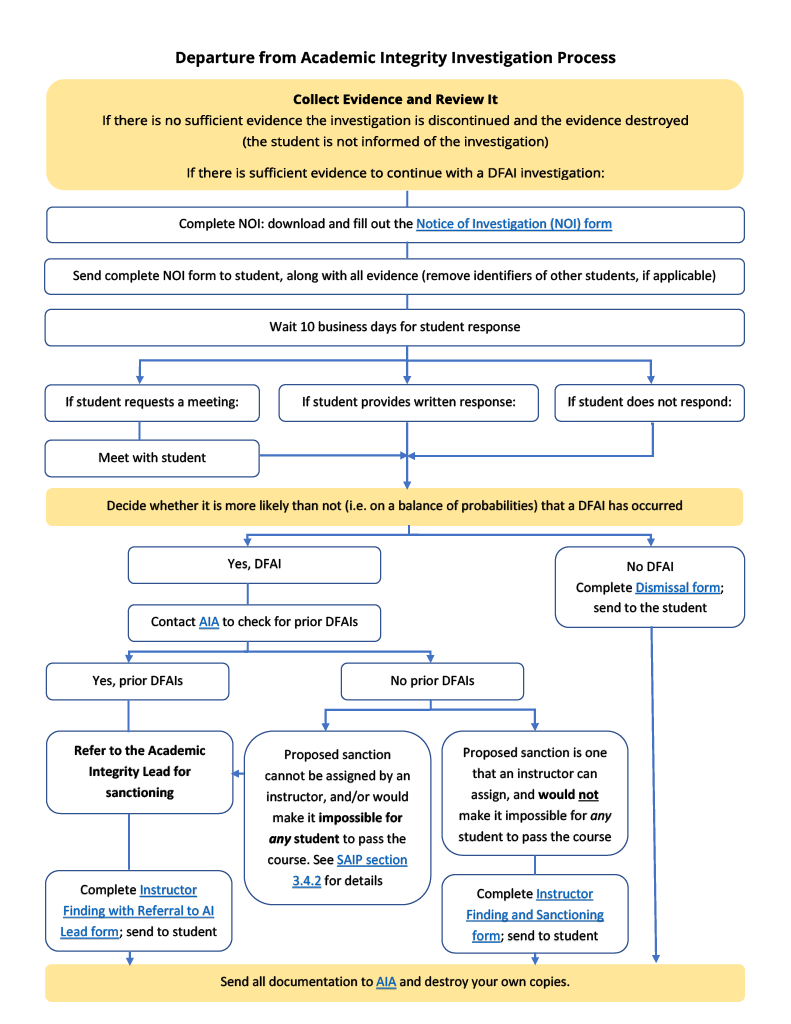
Departure from academic integrity flowchart

Last updated: Dec 11, 2025