
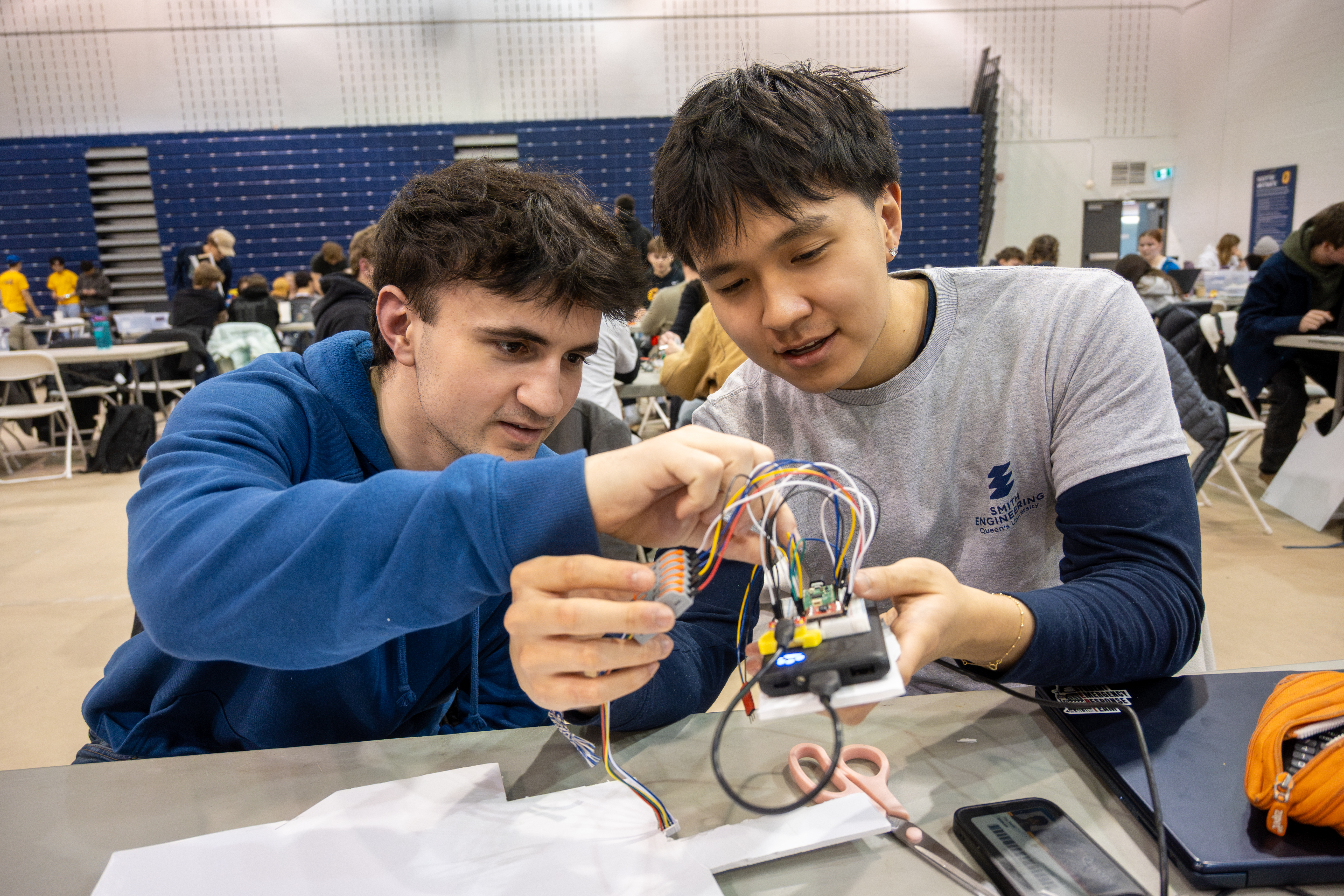
Jason Harris, a Teaching Fellow in Smith Engineering's Mechanical and Materials Engineering (MME) department, reflects on MechMania, a transformative engineering event, where engineering education is re-imagined in a weeklong immersive experience.
"MechMania is an intensive design challenge that integrates Mechanical and Materials Engineering students' second year, second-semester courses into one event,” explains Harris. “We take the entire second year Week 12 off for a cross-department design challenge. Within that challenge, we have content related to every individual course, combined for horizontal integration across the second semester."
Now in its second year, MechMania, inspired in part by Civil Engineering’s Civil Week event, has been initiated and championed by Dr. Roshni Rainbow. "Smith Engineering is pursuing its faculty-wide Reimagining Engineering Education project, and in 2024, there was a call for pilots," she explains. "I looked at what Civil was doing and thought 'why can't we do this?'" she says.
The result — scaled up for mechanical engineering, the Faculty's largest department — divides the almost 275 second-year students into randomized teams of five and presents those teams with a unique challenge. Harris, who led this year's MechMania, oriented the challenge around one of the United Nations Sustainable Development Goals, giving students a scenario featuring rural water distribution channels which were damaged and required an innovative solution. "This year was a water resources problem," he explains. "It took place over an L-shaped course, with three kinds of challenges." The first challenge was simply to have the students hit a target by rolling a ball about three metres; the second, adding a bank shot around a corner before hitting the target; the third, adding a crosswind.
But there were, of course, twists. Among other things, students had a limited budget and had to buy materials from a 'store', giving them a real-world constraint to contend with. There was also the introduction of pure chance, and a refocus on how students could engage with the challenge itself.
"There was a randomness to where students started the course this year; a kind of Wheel of Fortune wheel that determined where students placed their devices," Harris explains. "All of the actuating of the device, the aiming of it, and the release of energy had to be done via computer. There was no manual aiming, no manual release of energy — they could put energy in manually, but it had to be released remotely."
That constraint was an evolution from the previous year's MechMania, where students could manually aim and release from the devices they built; good for scoring, but not what the department was looking for as an educational outcome. "They could overcome their deficiencies by manually doing it," Harris says. This year, enforcing computer-controlled remote aiming and release "resulted in more innovation in the types of devices and mechanisms that the students created," he says. "This is exactly the kind of thinking we want to be fostering at Smith Engineering — if you have the innovation, performance will come with time."
"The teams that performed the best in the end were the teams that took the biggest risks," he says. "The team that won the qualifying round thoroughly read the rules of the competition and figured out how they could be on the very margins of the rules while still hitting the intent. Their solution to the problem was slow — they didn't get to attempt all their shots — but they still won because of the reliability of their design. The team that won the finals did something similar; they understood the rules and created something new that stood out with its creativity."
That year-to-year change in the competition regulations, and the resulting workflow shift, illustrates how MechMania itself is a kind of engineering project. "We have a problem we're trying to solve, so we need to understand that problem," Harris says. "We need to understand the interested parties at Smith Engineering: the students, our faculty, our staff, the community we practice in. We have external employers who are interested in the skills we develop. We have our academic outcomes." Harris has collected a tremendous amount of data from the event, ranging from quantitative information on student performance to qualitative feedback about how the community felt it went, and how they think it might improve. "We're collecting data, we're communicating our outcomes, and essentially, the goal is to have an activity that benefits the students and the program to validate the money and time that's being spent on this event."
Rainbow sees the event as something that doesn't sacrifice any of the learning a student would gain in a week of class but rather gives them a unique chance to synthesize everything they've learned. "If we didn't take the week to do this, what would likely happen in each class is they would still have a final project," she says. "This integrates them. It gets us to think about engineering not as subjects in silos; I'm going to my math class and then I'm going to my dynamics class, but as related tools that engineers can use. These types of intentional integration points give students an opportunity, a safe environment to integrate things like mechatronics and kinematics together in a project. It's a great fit for the design culture we have at Smith Engineering."
Harris also sees the week as an opportunity to foster community within MME and possibly give students a sense of where they're headed in their next years of education. "At this point, students are halfway through their undergraduate degrees," he says. "Second-year engineering is where you really start to form your engineering identity, moving from general engineering courses into specialization. This is an opportunity to form that community as they move into focus courses, and the students did a great job of supporting each other."
He is also grateful for the broad support for the initiative. "It was community of dedicated support staff, admin and instructors that came together to make the event happen, and I'm eternally grateful for that support, and for the participation, creativity and engagement of the students," he says.
Both Harris and Rainbow are keen to look at the data gathered at this year's event, with a mind to continuous improvement. "I'm looking forward to seeing what emerges," Rainbow says. "What are students learning from this experience, what are they gaining from it? What are they frustrated with, so we can improve it? I'm looking forward to trying it again; it'll be really fun."
Experience MechMania 2.0 with the full slide show: