As Artificial Intelligence (AI) and Large Language Models (LLMs) become more ubiquitous, usefulness remains a driver for their growth. Machines are becoming more powerful, but how does that benefit their creators and users?
In the Department of Electrical and Computer Engineering, Associate Professor Ali Etemad, a leading figure in AI research and head of the Human-Centered Artificial Intelligence and Interactive Machines Laboratory (Aiim Lab), is tackling these issues head-on.
“There are three main questions when it comes to the utility of AI in my research group: who you are, what you do, and how you feel — with an emphasis on ensuring that these questions are answered responsibly and ethically,” Etemad explains. “These all have implications on how AI can improve people’s experience, safety and security, health outcomes, and overall quality of life.”
‘Who you are’ can dictate how secure and personalized AI is in the day-to-day. “If I tell my smart speaker to play music for me, it can play music based on the history of music I’ve already played, if it could recognize my voice,” he says. “For you, it would play your kind of music. This is what we call identity recognition, which leads to deeper implications around not only security, but also personalized and customized interactions based on your identity.”
“‘What you do’ is what we call activity analysis or activity recognition. This applies to remote interaction with devices, using gestures, monitoring activities for health applications, for instance, and how active you are.”
“And ‘how you feel’ branches into emotional perspectives and health perspectives,” he says. “On the emotional end, we can develop algorithms that understand how humans are feeling emotionally and cognitively. That’s a big part of our research. The mental health and user experience implications of having AI understand our mental state are enormous.”
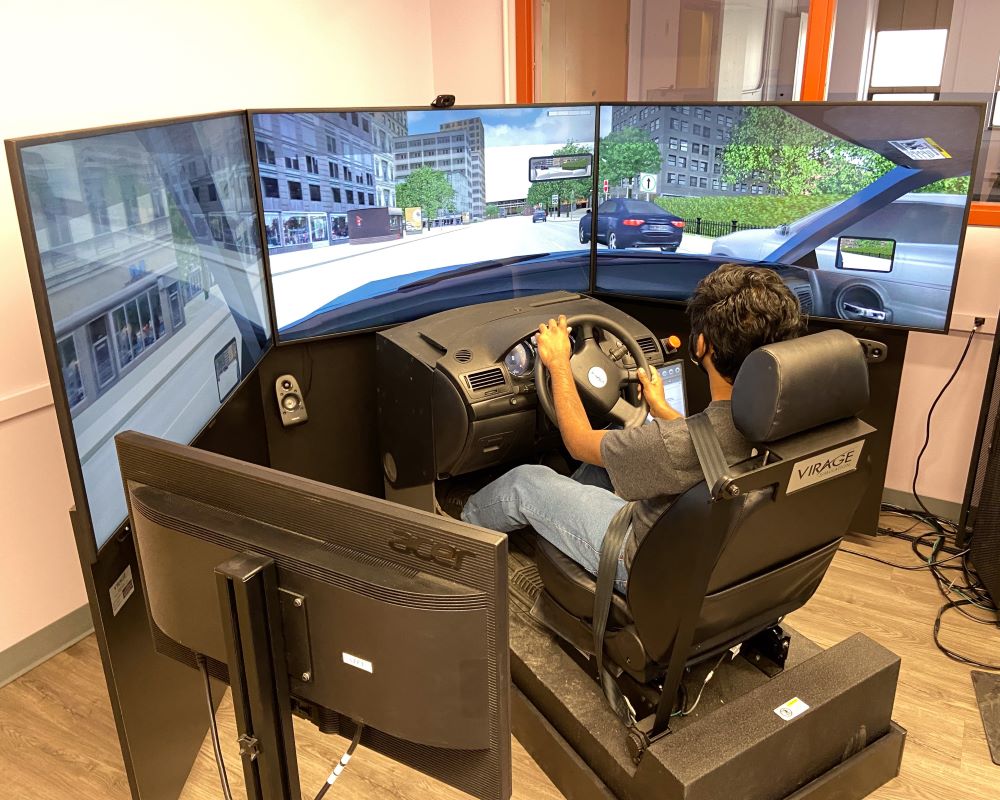
An example of how these concepts merge can be found in Etemad’s on-campus lab, where a driving simulator is wired to measure participants’ physical reactions, wearable signals, and even brainwaves. The new project — so recent that the team hasn’t had a chance to fully analyze the data yet — is to measure how people feel about active driving versus autonomous driving.
“We know what people say about being driven by an autonomous vehicle, but how do they really feel?” Etemad asks. “Now we can test this. Driving yourself, being driven by somebody, or being driven by an AI, with both regular and more aggressive driving. Understanding how people feel about self-driving cars is critical to understand how they might be received and adopted.”
“We have also been working heavily on large multimodal models recently,” he says. “In our recent work in collaboration with Google, we proposed a new way to reduce hallucinations — cases where models generate content that is unfaithful or incorrect — in large language-vision models,” he continues. The paper was recently presented at ICLR 2025, one of the leading conferences on AI.
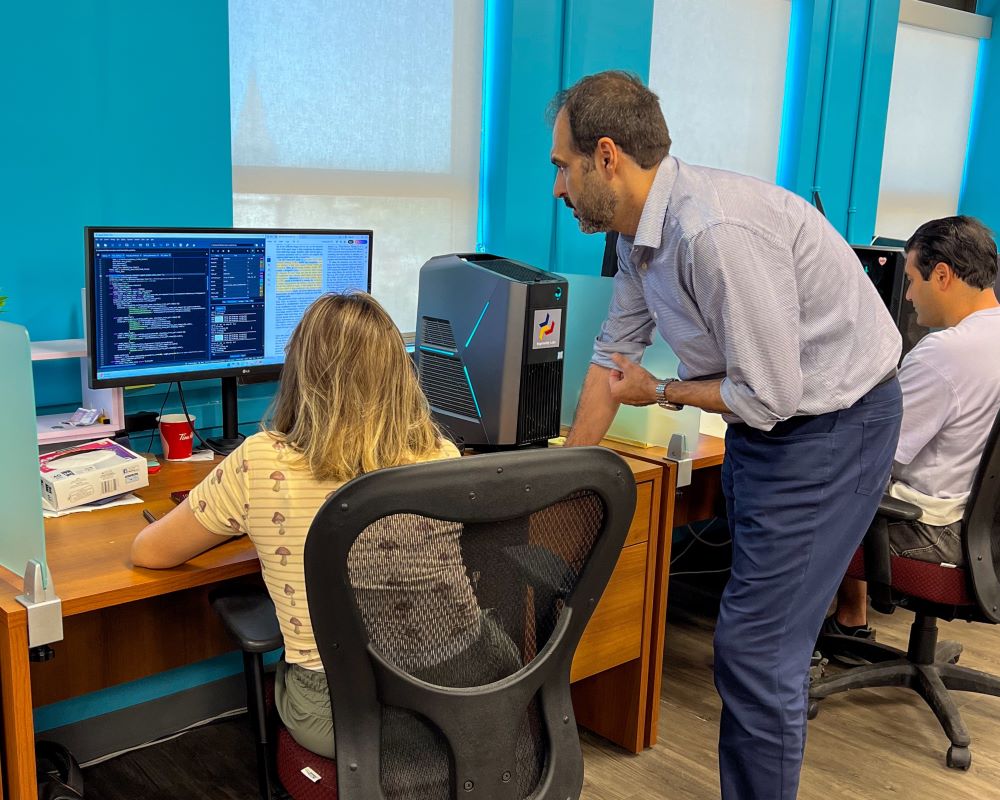
So, who’s leading the charge behind the research? Etemad’s lab is a hive of activity; he uses ‘we’ to describe their research exclusively. Over a dozen people can be active on projects at any given moment, ranging from undergraduate students to graduate students and post-docs and visiting researchers from around the globe. Etemad also works closely with collaborators at Ingenuity Labs, Queen’s AI and robotics research hub.
“As a research director, I’m only as good as my researchers,” he says of the Aiim Lab team. “I provide feedback, ideas and insights, but in reality — I tell them all the time, when we win an award, ‘this is you.’ I have very, very smart team members, and I’m privileged to work with them. I don’t like to use the word ‘hierarchy.’ Everyone brings and has their own experiences.” Relationships Etemad has cultivated in the lab extend beyond it. He now collaborates with former students that have gone on to their own successes in academia and the private sector.
Etemad’s recent sabbatical at Google Research further enriched his approach to AI. There, he worked alongside leading researchers on cutting-edge machine learning projects, an experience that continues to influence his lab’s forward-thinking direction. “You never really get away from writing proposals, whether it’s for grants or processor time in a cluster,” Etemad laughs. Determining what happens in the lab is a balance of what the team feels will have the most impact on users’ lives and being able to look ahead to see what research might still have an impact months down the road in a field that seems to evolve by the day.
Staying ahead means not only reading and following developments in academia, but the consumer space as well. “It takes a lot of reading,” he says. “Papers, and technical content, but also technology reviews, blogs, things that move beyond the academic into the big picture of where these products are headed.” Unsurprisingly, AI plays into this as well, with Etemad using tools like Google’s NotebookLM to synthesize papers in a conversation format to listen to while also doing daily tasks.
It’s an exploding field, partly due to the ethos of the people behind it. “The AI community has been notoriously bullish on open source, which is really, really good,” Etemad says. “The biggest positive characteristic of the AI community is the willingness to make things open.”
As LLMs become more monetized, there is more of a trend toward private and proprietary codes and data, but Etemad feels the industry is still borne by a spirit of open-source acceleration. “The data sets are public, the code is public, the algorithms are public, the papers are open access. The entire chain is kind of open and even conferences — which are often considered the key venues in AI, more than journals — there’s an unwritten expectation that methods presented should be completely reproducible, whether it’s providing the details in your paper, or providing a link to the code. I’d say 80%, 90% of our papers are completely open, the code is online, and the public can replicate it and get the same result.”
From a childhood pursuing coding as a self-taught passion in Iran, to a globally leading lab at Queen’s, Etemad feels privileged to be using his position to create better systems that improve lives.
“I think the next big explosion will be in augmented and virtual reality systems,” he says. “Meta, Google, and Apple are all putting a lot of effort into it. Others will follow soon. There’s a notion that the future of smartphones will be in a light glass form factor. You’ll need AI to support this functionality. You won’t have a keyboard; everything will be voice, gaze, and gestures. With AI catching up, processors getting smaller and batteries getting better, the Internet getting ubiquitous and faster… I think we’re moving toward that phase.”