
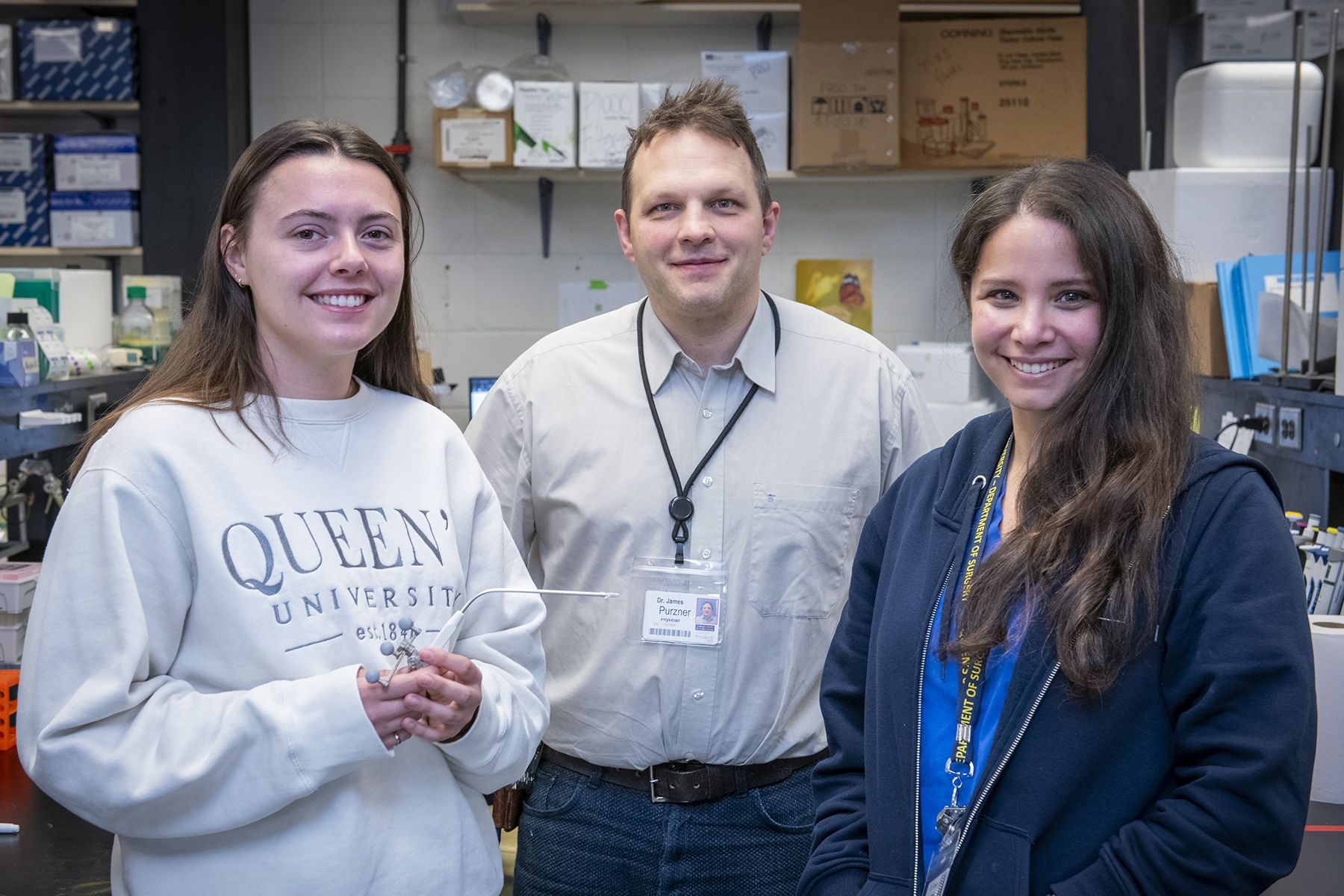
(L to R) PhD candidate Kaytlin Andrews, Dr. James Purzner and Dr. Teresa Purzner are the inventors of the new surgical tool. Photo courtesy of KHSC website.
When Kaytlin Andrews, Sc’23, was 13, her mother was diagnosed with glioblastoma. “The median survival is only about 14 to 16 months,” Andrews says. “Unfortunately, we only got about eight with her before she passed.”
More than a decade later, Andrews is working to change the outlook for patients facing that same disease.
Now in her third year as a PhD student in Biomedical Engineering, Andrews is helping develop and test a novel surgical biopsy tool designed to improve how glioblastoma samples are collected and studied. The goal is simple: enable better science in the lab, and ultimately, better outcomes in the clinic.
Rather than shy away from the disease that reshaped her family, Andrews chose to lean in. “Life is uncontrollable and you can’t really do anything to change the outcomes, but you can try to understand it,” she says.
Andrews grew up close to Kingston, and her father went to school at the Royal Military College of Canada. She applied to engineering programs across Ontario before accepting a major admissions award at Smith Engineering. The university’s reputation for supporting first year students through a demanding program sealed the decision. “Engineering’s known to be a difficult program,” she says. “It felt reassuring that the school itself was committed to you staying in and succeeding.”
She gravitated toward biomechanical engineering, drawn to what she calls “the intersection between health and engineering.” The discipline allowed her to combine mechanical systems with human biology. At the same time, she spent four years on the Baja Racing Team, eventually serving as co-captain. “By choosing biomech, I got to bridge mechanical parts and then the human intersection through the bio side,” she explains. “I was interested in understanding why things work the way they do, and how that goes together to move and exist and cause a system to work.”
In her fourth year, Andrews selected a capstone project that brought everything together: the development of a multi biopsy tool to better investigate glioblastoma. Current surgical biopsy tools can cause cross contamination, produce inconsistent sample sizes, and are not optimized for rapid scientific analysis. “They’re not really made for the rapid acquisition of samples specifically for a scientific context,” she says.
The project began with client meetings and technical requirement mapping, followed by extensive modeling and prototype testing.
The team built early versions at four to five times the intended size to test mechanical logic before scaling down. By the end of the year, they had produced a functioning design.
Now as a doctoral student, Andrews is continuing the work. In collaboration with neurosurgeons at Kingston Health Sciences Centre, the team conducted preclinical evaluations, comparing their device to the current standard of care tools. Surgeons tested both devices, while the research team analyzed video footage, weighed samples, and conducted histological assessments.
“We found that, even for experienced users, ours was more consistent and easier to use,” Andrews says. “The learning curve was fairly limited.”
With research ethics approval secured, the team moved into human trials. Using biocompatible materials and working closely with hospital sterilization teams, they successfully used the device in the operating room. The results have since been published in peer reviewed journals, and she has secured a Health Informatics and Data Scientist award from the Marathon of Hope Cancer Centres Network to advance human clinical trials.
Today, Andrews’ research spans engineering design, molecular biology, and machine learning. “My overarching project is quite a mix of disciplines,” she says. “I really appreciate my engineering background for that.”
She is considering a future in the biotech sector, where medical technology and innovation intersect. For now, she remains focused on the work at hand.
“There’s still not much that’s changed since the time my mom was diagnosed,” she says. “So, any opportunity to better understand it, I’ll take.”