
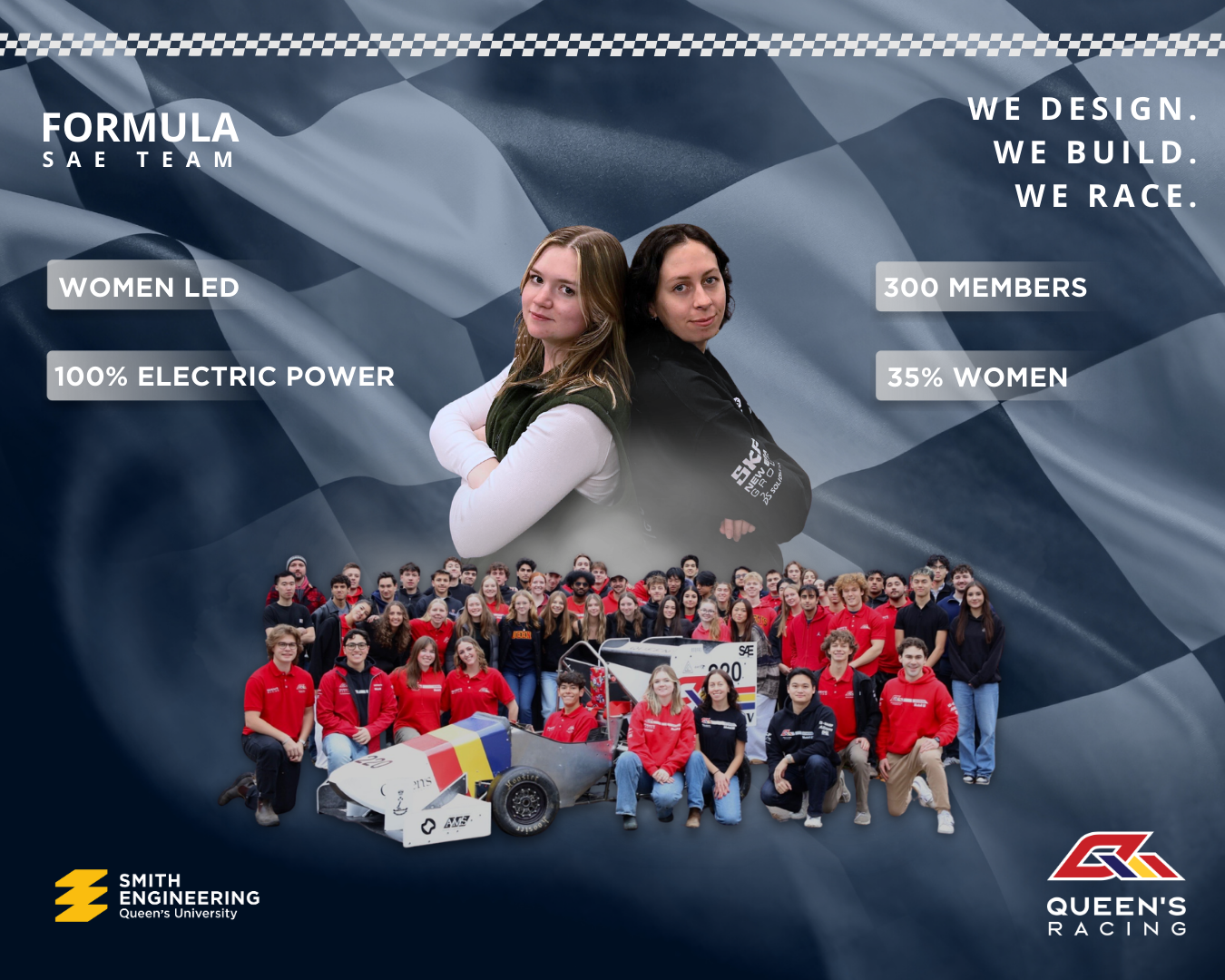
As competition season nears, the Smith Engineering Formula SAE team is rounding the corner to having its first event-ready vehicle in three years.
"We're in our third year of development for the team's first fully electric race car," says Lindsay Stroz, the team's co-director (with Joellie Duffy). "We're manufacturing our chassis and mechanical components, and we've just started bench testing our electrical system. Everything is going well, and we're hoping to test the car in mid-March."
Stroz and Duffy, both Mechanical Engineering students, say that the transition to electric has been a multi-year goal for Formula SAE at Smith Engineering, which made the switch from combustion engines during COVID. An international competition, the Formula SAE (FSAE) organization allows combustion, hybrid, or electric vehicles — but participating organizations must choose which to pursue.
The learning curve was steep — "we had to essentially scrap our electrical system and start from scratch after the first year," Duffy explains — and materials are expensive, with just a battery costing close to CAD$30,000. The cyclical nature of student-led teams, combined with COVID, also led to some lost knowledge transfer.
Persistence — and significant support from alumni, most recently the class of Sc’82 — has made the team competition-ready in 2026. Their first event is in April in New Hampshire, followed by another in Michigan.
Formula SAE competitions, however, aren't as simple as a race around a track. "We compete in a series of dynamic and static events," Stroz explains. "We have very experienced people look at every single facet of our design to tell us we're okay to go; from an electrical standpoint, a mechanical standpoint, even a water test to make sure everything's waterproof." Competition elements include administrative tasks, like Requests for Quotes (RFQs) and creating proposals; cars are evaluated on performance metrics like cornering, braking and endurance.
The varied facets of competition mean participating teams have to take a broad view of what makes a car successful. "FSAE teaches students how to take a large problem and dissect it into different areas," Stroz says. "So, with a component like endurance, you need a completely different focus than having a really high speed. You need to make team decisions about allocating your resources in different ways."
Adding breadth to the team's knowledge are Smith Engineering alumni. They are more involved with the team than ever, providing industry-insider advice and insights into the development process. "A lot of our leads this year were in second and third year, and Jo and I only have experience to a certain point," Stroz says. "We couldn't provide all the answers, especially on deep technical electrical issues. We reached out to our alumni and asked for help, and a lot of people raised their hands. Our leads meet with them regularly and they give them advice. We've been really leaning on them this year." Alumni mentioned include Lee McCay, Sc'14, Dalton Kellett, Sc'15, Raj Mattias Mehta, Sc'19, Muhammad Arham and Jean-Luc Deveau of Sc'20, Rob Teseo, of Sc'17 and Maurice Nayman of Sc'22, among others.
Recent years have also seen greater interdisciplinary participation. The shift to electric has led to more involvement from Electrical and Computer engineering (ECE) students; "the club has about 300 students overall, and about 60 of them are ECE," says Stroz. An electric system means there is no shortage of work for ECE students new to the team: "we have two dedicated electrical subteams, one for low voltage and the other for tractive systems."
With two women helming the team, participation by women has also risen. "We now have 35% women on the team, up from 5% last year," Duffy says. "Having female leadership has caused greater female involvement."
Involving women in automotive engineering is a cause close to both of their hearts. Duffy, who grew up working on cars with her brother ("at 16, I got my first project car," she says), moved into engineering to have a direct hand in the future of automotive design. Stroz has recently completed internships at General Motors and Magna and has worked concurrently with her studies as a race engineer. The two founded the Queen's Women in Automotive and Motorsport annual conference after meeting in the Formula SAE club several years ago.
"As the first female duo to run the club, we're proud to be in this position," Duffy says, also mentioning their faculty advisors, Chair for Women in Engineering Heidi Ploeg and Mechanical and Materials Engineering professor Barbara da Silva.
"Design teams are the pinnacle of engineering experience," Stroz says. "This is where engineering students learn hands-on skills and problem solving, and working with alumni has really shown how they connect to their experience on design teams. As a fully self-funded club, their encouragement, both through expertise and direct support, means the world to us."
Support the Formula SAE Team today!