
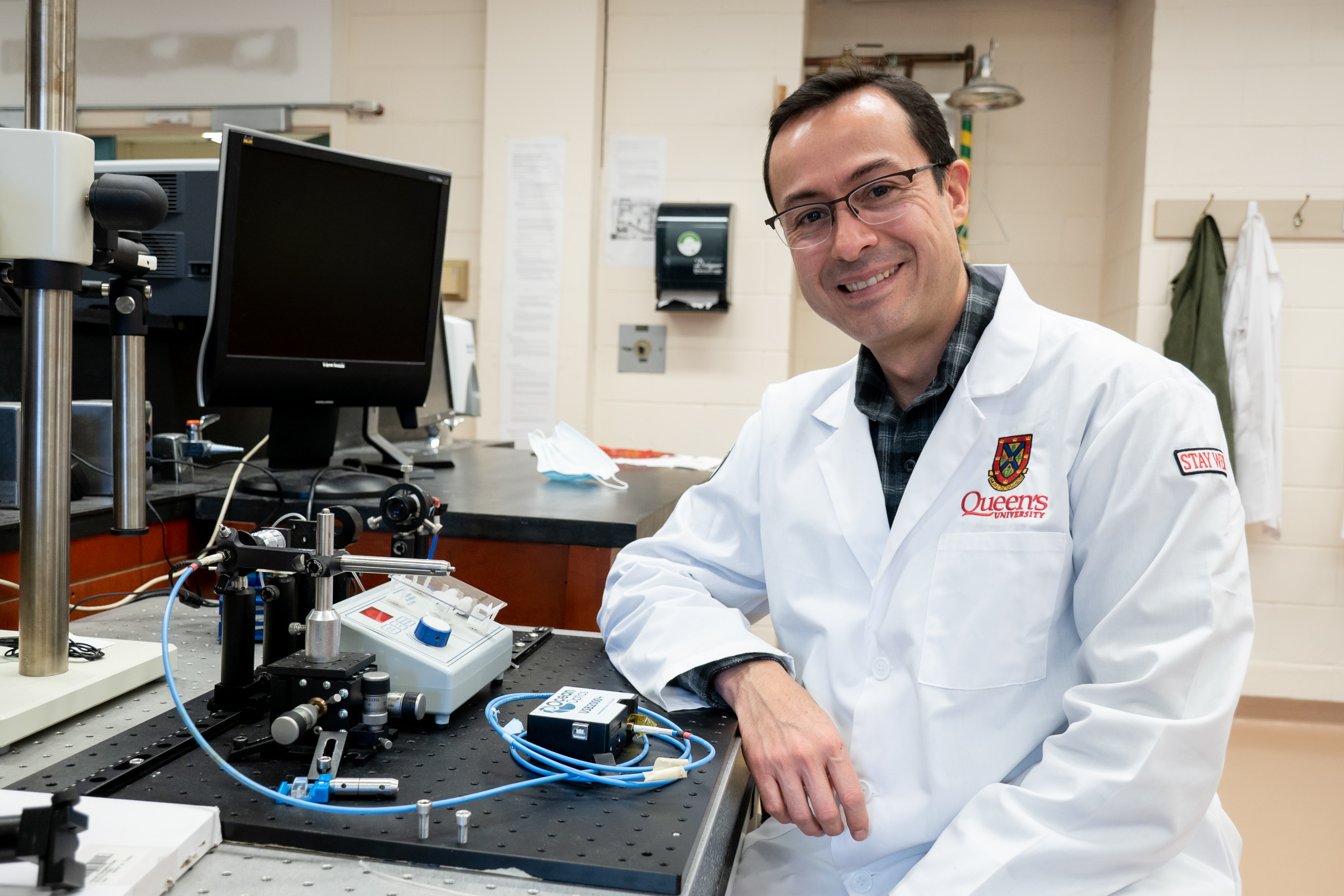
A federal government program that has delivered many Latin American students to Queen’s is now helping to send a Smith Engineering faculty member south for joint research opportunities.
A Professor in the Department of Chemical Engineering, Carlos Escobedo will be heading to Costa Rica with the support of a 2026–2027 Emerging Leaders in the Americas Program (ELAP) Faculty Mobility and Partnership Building grant.
The ELAP program, funded by Global Affairs Canada, has long supported student exchanges between Canada and Latin America, and Escobedo has seen firsthand how impactful those student exchanges can be. Over the past decade, he has hosted three ELAP-funded students in his lab.
“This initiative is fantastic,” he says. “There are many successful stories from the ELAP students who started as an exchange, as an internship, and ended up being master’s and then PhD students here. They have been fantastic, very prolific students.”
Now, through the faculty mobility stream of ELAP, Escobedo is taking that success a step further by traveling to Latin America himself. His upcoming visits to Costa Rica are designed to establish long-term research collaborations, create new training opportunities, and build pathways for sustained academic exchange between institutions.
Costa Rica emerged as a natural partner through a combination of strategic alignment and personal connections. As Smith Engineering’s representative for Latin American engagement, Escobedo has been actively involved in international outreach efforts, including collaborations through the CALDO consortium of Canadian universities. These efforts identified Costa Rica as a promising partner, particularly in the rapidly growing field of semiconductor research.
“There’s a huge interest from the Costa Rican government and universities to work in semiconductors,” Escobedo says.
That alignment was further strengthened through an international conference, where Escobedo connected with Costa Rican researchers working in similar areas of sensor technology and plasmonics at the National Nanotechnology Laboratory (LANOTEC) and the National Centre for High Technology. The relationship quickly developed into a collaborative opportunity, reinforced by a subsequent visit from Costa Rican university representatives to Queen’s campus.
Under the ELAP grant, Escobedo plans to travel to Costa Rica beginning in summer 2026, with the possibility of a second visit later in the year. The visits will focus on three key areas: advancing joint research, delivering educational outreach, and establishing frameworks for ongoing mobility between institutions.
On the research front, Escobedo’s team specializes in developing nanoscale and microscale sensors, including microfluidic platforms capable of detecting micro- and nanoplastics. This work aligns closely with environmental priorities in Costa Rica, where plastic pollution poses significant challenges, particularly given the country’s reliance on tourism.
“They are very interested in technologies that can detect and handle plastics at small scales,” says Escobedo. “This is something we have in common, both countries and research groups.”
The collaboration will also include hands-on workshops and seminars for students, offering training in micro- and nanotechnology fundamentals, as well as practical experience with fabrication techniques. Escobedo envisions these sessions as a way to share expertise while also identifying future research talent.
Beyond technical collaboration, a central goal of the initiative is to formalize partnerships between Queen’s and Costa Rican institutions. Escobedo plans to meet with university leadership to explore opportunities for student exchanges, joint programs, and expanded faculty mobility.
While this faculty mobility grant represents a new chapter in Escobedo’s work, his message to colleagues about the broader ELAP program is clear: take advantage of it. He emphasized the high calibre of students from Latin America and the long-term benefits of engaging with the region, including one of his current Teaching Assistants who has now received two consecutive awards for his work while also contributing strong research.
“There is very high-quality education and research happening in Costa Rica” he says. “We can benefit a lot from those collaborations.”