
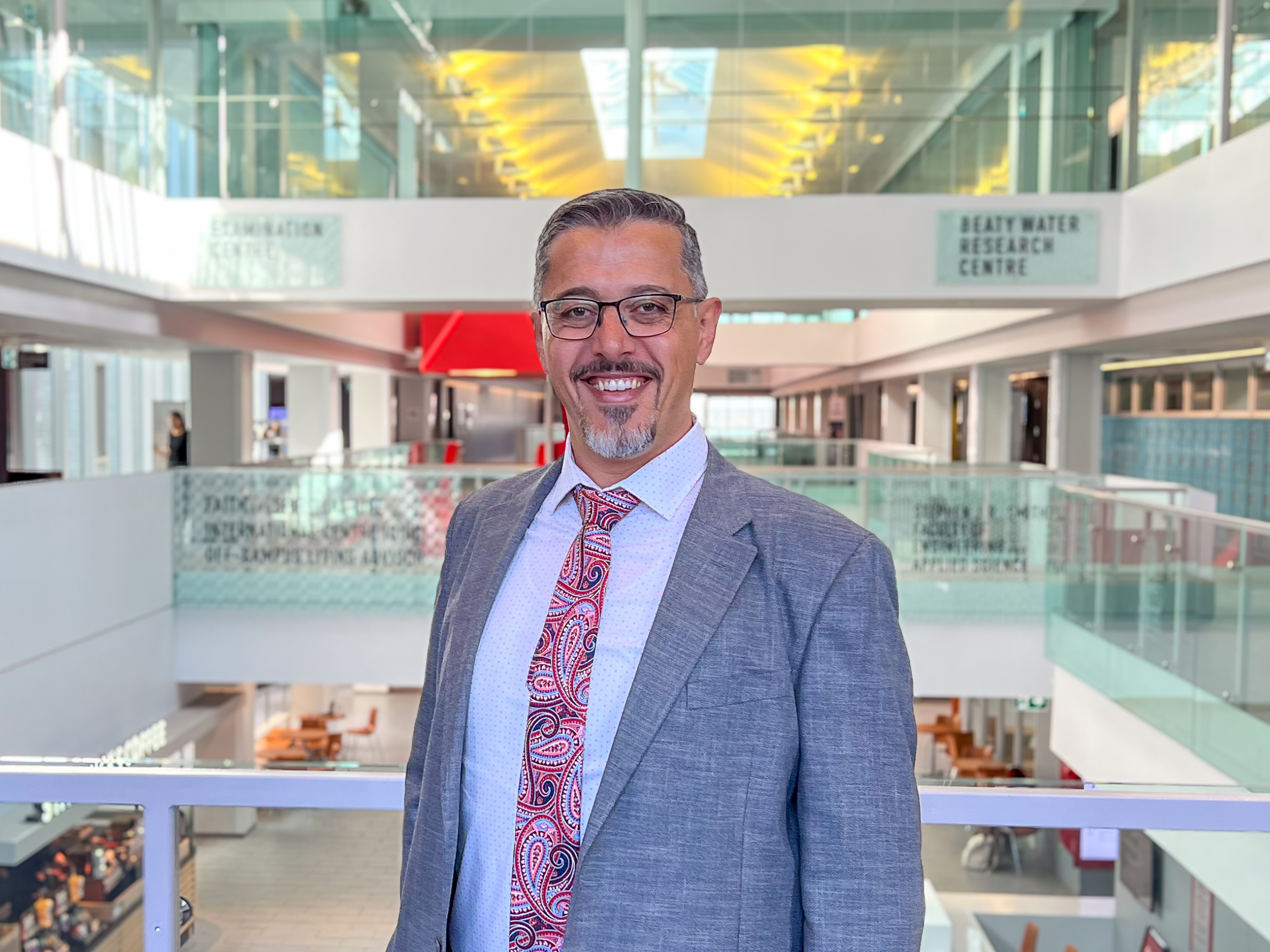
As Queen’s first recipient of a Scotiabank Global Climate Action Research Fund grant — one of only 10 awarded every year — Mahmoud Alzoubi is seeing his work recognised, and in the context of a globally growing interest in energy efficiency.
“Energy efficiency is not just about reducing power use,” he explains. “It has multiple benefits: reducing carbon emissions, lowering costs, extending equipment lifespans while reducing maintenance needs.”
Alzoubi’s particular focus, through his Energy Efficiency Engineering Laboratory, is hydrogen. As a cross-appointed academic in both Mining and Mechanical & Materials Engineering, he is trying to bring hydrogen to the mining sector as a viable alternative to their current fuels.
“Mining is looking at reducing its carbon footprint, a common source of concern,” he says. “What I am looking at is hydrogen as an alternative fuel in the industry. Currently, mining operations rely largely on diesel, natural gas, and methane. Investing in alternative sources is not just a climate solution, but an economic one.”
Alzoubi was deeply gratified to see his project receive the Scotiabank grant. “When they requested a video call with me following my application, I thought it was to provide an update or ask for clarification,” he laughs. It recognises the work his lab is doing in energy efficiency, and his own commitment to hydrogen as a key area of his research. “In academia, research has no real endpoint,” he says. “The deeper you dig, the more you realise how little you know.”
His work includes studying hydrogen within the context of energy systems. Within the fuel value chain — production, distribution, storage, and utilisation — his work focuses mostly on the “utilisation” phase.
The number one concern in the mining industry? “Safety — always safety,” Alzoubi explains. “There is no comprehensive analysis on the safety and risk of using hydrogen, either in surface mines or underground mines, and we first need to understand the safety issues before we can create a roadmap toward hydrogen implementation.” The Energy Efficiency Engineering Laboratory has five graduate students and three undergraduate students working with Alzoubi — one of the undergraduate students contributed to hydrogen analysis and won second place for a poster presentation on hydrogen research at the CIM Connect in Montreal in 2025.
The second challenge, after safety, is cost. “Cost of production is the second concern, and mining equipment is difficult and expensive to update,” he says. “Our future plans include more research on how to implement hydrogen into machines currently operating on diesel or other fossil fuels.”
Investigating hydrogen as an alternative fuel source, and how to retrofit mining equipment to use it safely, is only one area of Alzoubi’s research. Other projects include research on artificial ground freezing to mitigate permafrost degradation affecting northern infrastructure. In addition, another area of his work looks at decarbonising mine ventilation in northern operations. In parallel, in collaboration with a professor in Engineering Physics, he is working on improving the thermal management system for a balloon-borne payload; a project carried out in collaboration with multiple universities and supported by NASA and the CSA.
The Scotiabank grant allows Alzoubi to hire more graduate students and move his hydrogen research forward more quickly. In addition, the recognition provides legitimacy; as he puts it, “a stronger platform to advance our research into something that supports a fuel solution that’s cleaner, more efficient, and resilient.” Alzoubi is optimistic about hydrogen’s role in mining. In some cases, even less efficient production pathways can remain cost-competitive with natural gas, while offering clear environmental benefits.
“There are different ways to classify hydrogen,” Alzoubi says. “When discussing low-carbon options, terms like ‘blue’ and ‘green’ hydrogen often come up, depending on how it is produced and whether emissions are captured. In contrast, more carbon-intensive pathways remain less sustainable. While some hydrogen production methods are still relatively costly, they can be comparable to natural gas in certain scenarios. At the same time, hydrogen is not yet produced at the same scale as fossil fuels, and Alzoubi is mindful of the cost, infrastructure, and production complexity when considering its adoption in the mining sector.”
As he says, the Energy Efficiency Engineering Laboratory’s research on hydrogen has to be accompanied with a mindset of what is useful to the industry; not only advocating for the energy source, but also how it can serve a practical and dependable solution.
“Our ultimate goal is to make it not a taboo subject,” he says, “but something that the industry can trust as safe and reliable.”