James Larsen has taken a unique entrepreneurial journey that integrates his passions for technology, sustainability, and innovation. His career has become a reflection of the growing emphasis on sustainability in the energy sector, particularly in the realm of energy storage solutions.
Upon completion of his degree, Larsen (Sc'03, Mechanical Engineering) stepped into the burgeoning hydrogen fuel cell industry in Vancouver, viewing it as a stepping stone towards realizing his professional aspirations. This move was instrumental as it not only deepened his technical knowledge but also provided him with crucial insights into the evolutionary dynamics of cleantech.
Larsen's career path then shifted toward project engineering and management roles within a large EPC firm. During this period, he recognized an acute need for innovative solutions that addressed the energy transition, particularly those that would support the transition toward renewable energy sources. Understanding the significance of these developments for future sustainability, he pursued an MBA at Ivey Business School.
The absence of a sustainability club at the school inspired him to take action; he founded the Sustainability Club, which aimed to rally fellow students around environmental issues. This initiative catalyzed interest in sustainability among his peers, highlighting the slow but significant shift in attitudes toward cleantech investments.
“Following that, I worked at Bain & Company, a strategy consulting firm,” he says, “and was working on a variety of different types of engagements, such as pricing strategy, private equity diligence, and market expansion strategy, for a diverse set of clients. Though I wasn't working in sustainability, I was able to draw a lot of insights and experience from it, and after I worked a few years there I felt that I had acquired the technical and business acumen and was ready to go and find a cleantech startup that I could lead.”
A pivotal moment in Larsen's career came when he joined e-Zinc in 2018 as CEO.
“I was introduced to Dr. Gregory Zhang, who is the late founder of e-Zinc, and he had developed this new zinc-based battery technology focused on long duration applications,” he says. “And so here right in my backyard in Etobicoke was this really unique differentiated technology. I saw it as a tremendous opportunity.”
The company, dedicated to developing a zinc-based battery technology that targets long-duration energy storage applications, aligned perfectly with his vision of transforming the energy landscape. At e-Zinc, he witnessed the potential of energy storage to serve as a key enabler for the energy transition — especially in the context of increasing reliance on renewable energy sources. Through his leadership, the company has grown from a handful of employees to a robust team of 55, supported by substantial funding of approximately CAN $80 million along with CAN $20 million in Canadian and U.S. grant funding.
Larsen articulates his commitment to energy storage, emphasizing that conventional technologies — primarily lithium-ion batteries — fall short of the demands of modern energy needs. Current storage methods typically cater only to short-duration applications, which leaves a gap in the market that e-Zinc intends to fill. The challenge lies in constructing energy storage systems capable of sustaining energy supply over longer periods, which is crucial for customers reliant on renewable energy sources.
e-Zinc deployed its first system in the field a couple years ago at a compressed natural gas facility in Woodstock, Ontario. This project highlighted their technology's capacity to integrate with both solar power and the main grid, providing an all-encompassing energy storage solution. The performance insights gained during this pilot phase facilitated ongoing technological improvements, which culminated in the recent launch of a new product design. This design leverages injection-molded parts, improving efficiency and reliability compared to previous machine parts.
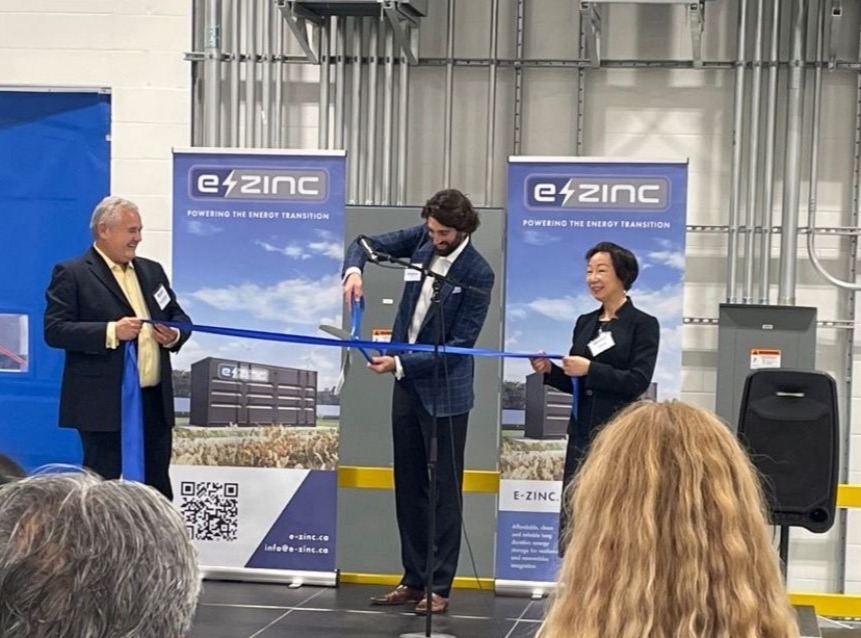
“In parallel with that, we've just finished building out a new 42,000 square foot manufacturing facility in Mississauga and this summer we’ll begin the process of building our first two commercial pilot projects,” he says. “We have a project with the California Energy Commission and a project with Toyota Tsusho and these are going to be the world's first 24 hour duration, battery energy storage systems.”
“It's a huge flag for e-Zinc to put in the ground, and one for Canada as well.”
A key advantage of e-Zinc's technology is its modularity. While traditional storage systems, such as pumped hydro, require enormous infrastructure investments and are geographically constrained, e-Zinc's approach allows for scalable solutions that can be deployed in a variety of settings. This flexibility presents immense advantages for energy providers aiming to implement innovative energy solutions without the need for overwhelming capital expenditures.
Larsen's journey serves as a representation of a generational shift toward sustainability in the workforce. Today's interns at e-Zinc, eager to contribute to the energy transition, have expressed a long-standing desire to work for the company, reflecting a broader trend among the younger generation that now prioritizes sustainability within their career aspirations.
The fusion of Larsen’s professional journey with his childhood experiences, particularly his summers spent on the Sunshine Coast of British Columbia, creates a compelling narrative of purpose and passion. He developed a love for nature and sustainability that imbued his career choices with personal significance. As he continues to lead e-Zinc, Larsen not only exemplifies the intersection of engineering and environmental stewardship but also underscores the vital role of innovative energy storage as society progresses towards achieving decarbonization goals. His success is a testament to the evolving landscape of cleantech — a promising horizon propelled by engagement and passion for a sustainable future.