
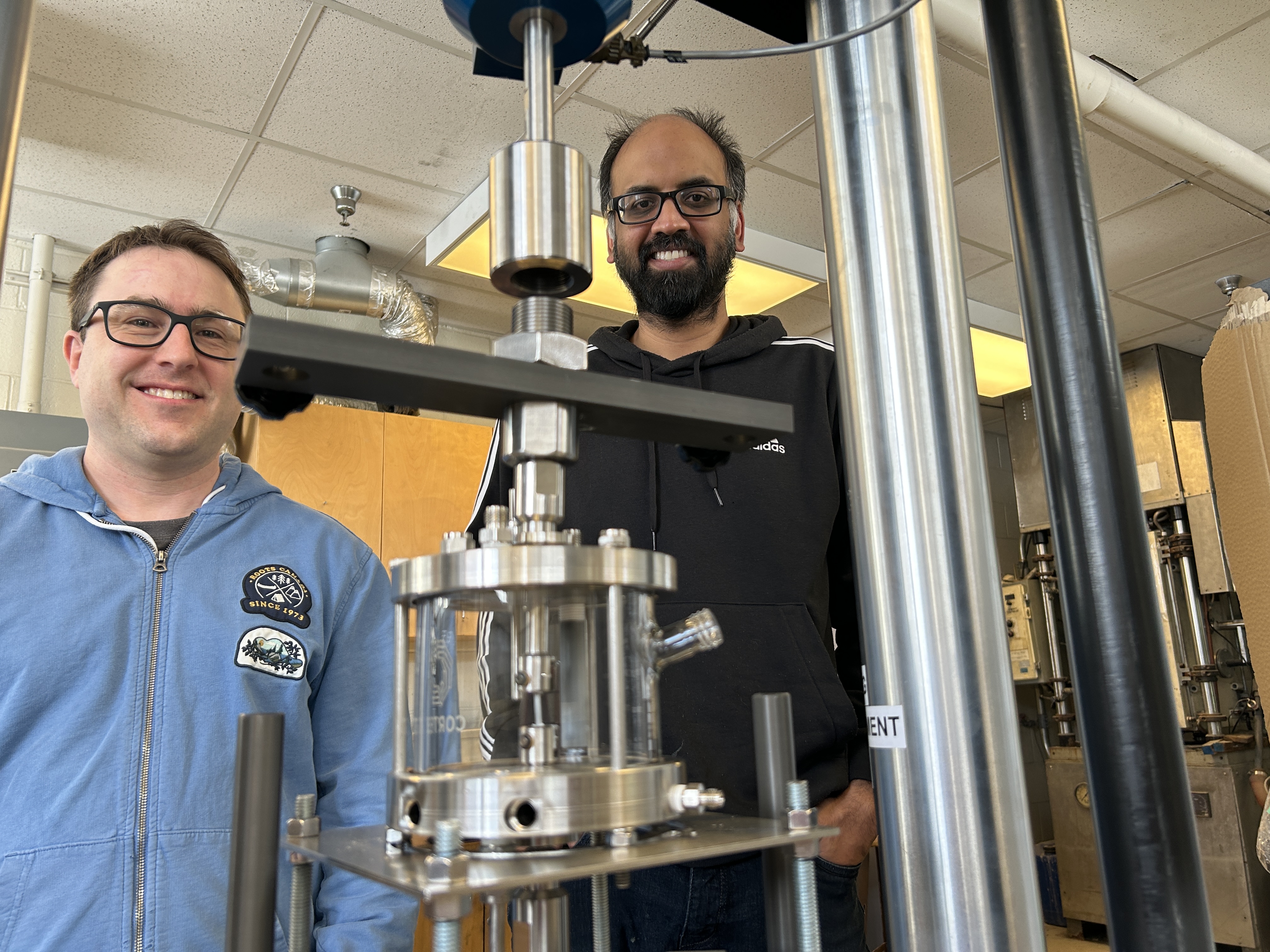
Corrosion is often an unavoidable material degradation process that costs trillions of dollars annually — and the research focus of this year's Smith Engineering Excellence in Research Award (SEERA) winner, Suraj Persaud.
Persaud has built his career studying the effects of corrosion and how to mitigate them. "In terms of its importance worldwide, corrosion doesn't change," he says. "It always costs somewhere between 3 and 5% of GDP around the world, always. Even though you are solving problems, technological innovations are always creating new ones."
Persaud's interest lies in the corrosion relevant to nuclear power technologies, a vital topic for meeting the world's growing power needs and combating climate change. "Corrosion is a major marker of the lifetime of current [nuclear] plants. How they operate, how long we can expect them to last, it often comes down to material science and corrosion," he explains. The nuclear industry's focus on corrosion drives many advances made in this area: "It’s [the nuclear industry] persistently at the leading edge, through the past half century, and an initiator of new techniques or understanding," he says. His lab, the Persaud Corrosion Group (www.persaudcorrosion.ca), specializes in the metallic components of these systems.
A key area of current research examines stress corrosion cracking, an issue that spans nuclear and other industries, such as oil and gas. "We look at novel systems, high temperature gas and molten salt [for example] — how materials fail and the science behind why they fail," Persaud says. "If you can figure out why they failed, mechanically, material-wise, or chemistry-wise, then you can design better materials, optimize chemistry and develop inhibitors. The number one priority in the research we do is try to help ensure public safety, not just in nuclear power, but also for energy technologies generally."
Persaud's research explores how to extend the life of current nuclear plants and ensure a long-term solution for the disposal of nuclear waste, as well as the newer, promising area of small modular reactors—seen by some as a potential solution to the ongoing climate and energy crises. "Corrosion is the key technological knowledge gap that hinders the deployment of novel small modular reactors," Persaud says. "On paper, these reactors are fantastic designs. But the ultimate question comes when they have to be built using materials that can withstand novel coolant environments for a period of time. SMR developers and regulators require a detailed corrosion characterization to build confidence."
"The industry relies on work done at universities — what we do is partly where their confidence is coming from. University researchers can express confidence that a material, with its corrosion characterization, can extend the life of a reactor or support new reactor designs."
Persaud attributes much of his success in research and funding — and the SEERA — to the Corrosion Group, where Senior Research Associate Kevin Daub manages a group of almost two dozen researchers. Formerly a scientist at Canadian Nuclear Laboratories, Daub credits the lab's strength to a strong crossover between industry and academia. "Many leading corrosion professors have industry experience first. They're skilled at bringing in students to their labs, offering students a direct application of their studies, which gets students excited," Daub says. "Courses tend to be very applied; not a black-and-white 'here's the solution' approach, but one where you solve a problem — here's an answer, but we need to see if it's usable, if there are alternatives, and finally does the solution balance many considerations. Corrosion studies lend themselves to complex engineering problems."
At the Persaud Corrosion Group, research breaks down into materials — generally Persaud's area of expertise — and chemistry, which is Daub's specialty. "When you look at the nuclear industry, systems tend to be very clean, but nothing is perfect," Daub says. "We look at what can get in there as a chemical and how it'll react. Whether it's a current reactor environment, waste disposal, or a proposed future design, we introduce an element, make it fail at an extreme, and then go back to adjust conditions to see what's realistic." This approach allows key thresholds and conservative boundaries to be set.
The group prioritizes a flat structure, required to keep the many students active and myriad projects moving forward. "You need somebody as talented as Kevin to come in as senior research associate; almost a second professor here every day managing the lab, the experiments," Persaud says. "This gives us multiple experts, where I am more in charge of project direction, and Kevin, project management."
"We have a structure where we have post-docs, graduate students, and undergraduate students," Daub explains. "There are research streams — waste, advanced reactors, small modular reactors, current plants. Our structure gives our students room to work on their projects, and when they stumble or aren't ready, we can step in. Everyone comes to group meetings once a week, where we ask, 'What's your problem?' and a room full of people are there with you to get you unstuck. There's never one individual on their own on a project in a corner. They're always sharing techniques and equipment with people they can bring a problem to."
The secret sauce to problem-solving, Persaud says, is the variety of minds in the room. "There's diversity within the group that's working together — people from all over the planet, various genders and races," he says. "They're all talking about the experiences they've had in their lives. They are all a little bit different, and able to combine different personalities, come together and work together."
The results of the Group aren't just felt locally, but internationally. A recent student contingent to the International Conference on Long Term Prediction of Corrosion in Nuclear Waste Systems won awards. "The international community was impressed with Canadian students that know what they're talking about with this global problem," Persaud says.
The other key component in the lab is the active involvement of industry. "The industry partners we work with are fantastic. Our research focus brings in partners including nuclear utilities, Ontario Power Generation, Bruce Power, Canadian Nuclear Laboratories, and the Nuclear Waste Management Organization. There are two partner-funded chairs in this area, including a UNENE Research Chair in Corrosion. We work with the regulator on small modular reactors; we work with Natural Resources Canada — we basically work with the entire Canadian nuclear industry."