
Every Queen’s Undergraduate Internship program (QUIP) experience is different. While many students pursue industry-based roles, a growing number of opportunities are emerging within research projects on campus, offering a hybrid experience that blends employment with academic inquiry.
That combination is at the heart of a recent QUIP experience undertaken by fifth-year mechatronics and robotics engineering students Ryan Berry, Sc’26 and Grant Keefe, Sc’26. Their internship, rooted in a major federally funded research initiative, demonstrates how QUIP can support ambitious, student-driven projects with real-world impact.
The project began not as a faculty assignment, but as a student-led idea. Building on past experiences with the Queen's Aerospace Design Team and exposure to search and rescue work, Berry and Keefe worked with fellow students to develop a grant proposal for the federal government’s Search and Rescue New Initiatives Fund in collaboration with faculty supervisors, ultimately securing $550,000 in funding over three years.
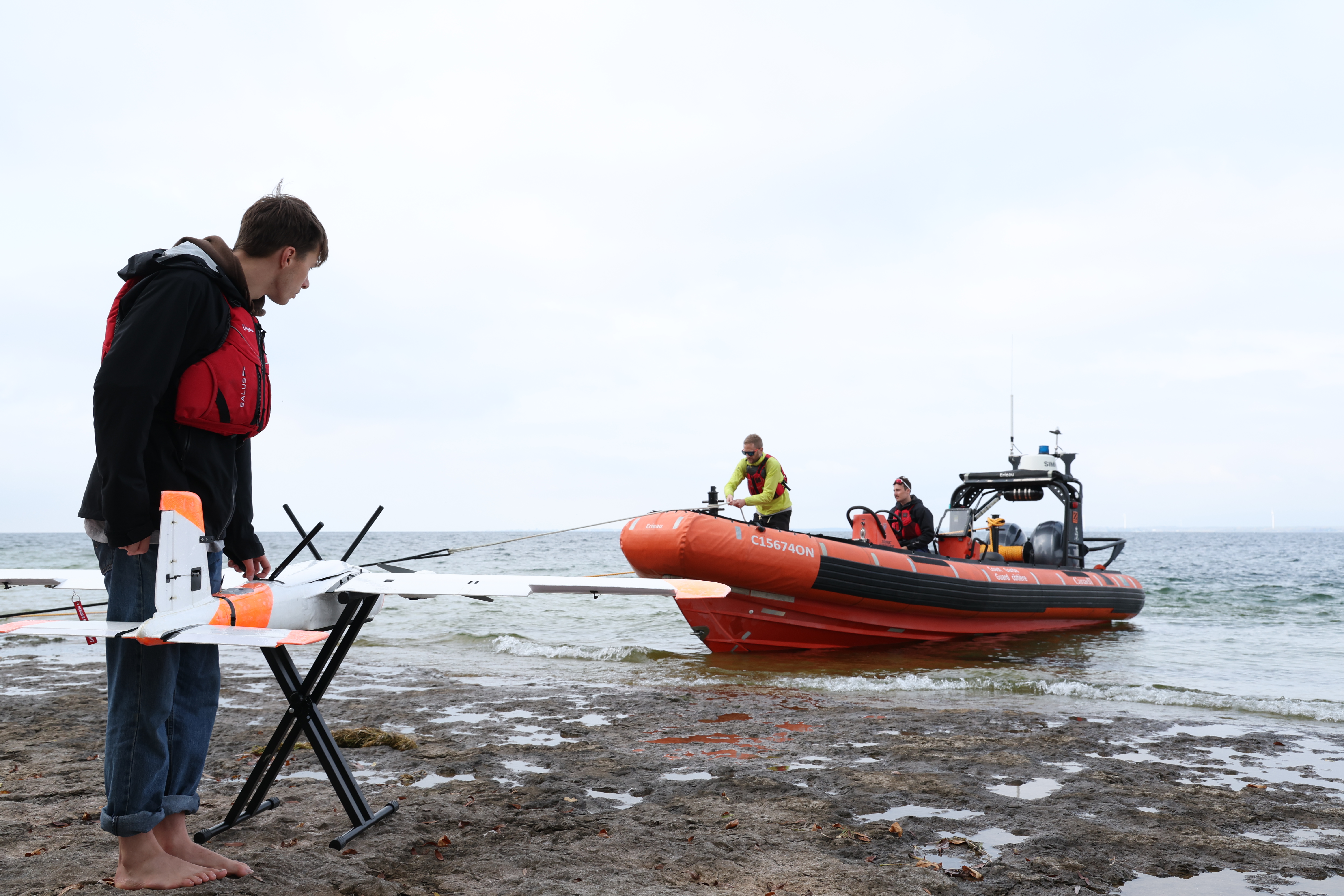
Once the project was approved, the pair transitioned into QUIP internships to bring it to life. Their work focused on developing a small, deployable aircraft that could assist the Canadian Coast Guard in search and rescue operations. Designed to launch from rescue boats and land on water, the aircraft integrates sensing and detection systems to identify objects or individuals in distress.
The experience extended well beyond traditional undergraduate research. Through the project’s partnership with the Coast Guard, the students participated in field testing, training, and real-world application. They even travelled to the Canadian Coast Guard College in Nova Scotia to complete a two-week course in search and rescue planning, gaining direct insight into the operational challenges their technology aimed to address.
“I have previous summer work experience with the Canadian Coast Guard, which gave me industry-specific insight and understanding to support the research grant we secured,” says Berry. “We also had access to incredible mentorship and support from our faculty supervisors; they empowered us to take initiative and really drive this project forward, putting a lot of faith in us and providing so much valuable insight along the way."
Internships provide technical experience, but students also gain life skills useful in more than just professional situations. "I think the number one skill I developed throughout my internship was confidence,” says Keefe. “Through field testing, I experienced firsthand how challenging and unpredictable real-world work can be. It pushed me to break down complex problems into manageable steps and work through them independently. As a result, I feel I've developed the confidence in my ability to tackle unfamiliar challenges and find solutions."
Their internship also illustrates one of QUIP’s lesser-known advantages: the ability to support on-campus, research-related projects. For students like Keefe, who is also a varsity athlete, remaining at Queen’s while completing a full-time internship made it possible to balance academic, athletic, and professional commitments. It also underscores the program’s flexibility in accommodating diverse student pathways.
“Opportunities like this give students insight into the real-world application of research conducted on campus. They get their professional internship designation and get to participate in research initiatives that have the potential to really impact society,” said Jess Boland, Associate Director, Corporate Relations at Smith Engineering. “They don't have to choose between one or the other.”
While Keefe and Berry’s time on the project is ending, a new round of QUIP interns will be hired this fall to continue the work under Professors Jonathan Gammell and Melissa Greeff. A master's student is also working on the Coast Guard drone project.
Gammell noted that with some proactive planning and deliberate selection of both project and personnel, faculty hiring QUIP students to work on a research project can be an effective model both in providing students with professional work experience and in achieving meaningful research outcomes.
“There's a real value in working with people who can own a research project,” said Gammell. “There's also a freedom in working with employees who can do necessary and important engineering work and a value in the permanence of having that person full-time for up to 16 months.”
“As Smith Engineering focuses on reimagining engineering education, this entire experience has really embodied it for me,” said Greeff. “It’s about leadership. It’s about students working with government and industry stakeholders, taking ownership of projects, they are passionate about, and that have a real impact on society. It’s exciting to see.”
For students interested in learning about internships, visit the QUIP website for more information. For faculty members interested in hiring Smith Engineering students for on-campus internships, connect with Jess Boland at jess.boland@queensu.ca. For faculty members in other faculties interested in hiring students for on-campus QUIP internships, contact quip@queensu.ca.
Field photos by Vidya Menon.