Biomedical Engineering

The Collaborative Masters Program in Applied Sustainability (CMAS) is an innovative program. Building on the applied sustainability strategic theme of Smith Engineering at Queen's, the objective of the CMAS program is to expose students to the implementation of sustainable engineering solutions within the context of broader sustainability theory. To do this properly, engineering students must not only advance their technical education, but must gain insights into how public policy impacts on the success of engineering solutions to multidisciplinary sustainability problems.
The program is a collaborative effort with faculty members from six programs within the faculty: Chemical Engineering, Civil Engineering, Electrical and Computer Engineering, Geological Sciences and Geological Engineering, Mechanical and Materials Engineering, and Mining Engineering. A unique aspect of the CMAS program is that it includes a component on the importance of Government Policy in the successful implementation of sustainable technology solutions.
The School of Policy Studies provides a module in the core course (CMAS 801) that discusses various policy strategies that drive the reduction in carbon emissions and the preservation of the environment. CMAS students also are required to take one course related to how policy encourages sustainable practices, for example: Environmental Planning in municipal governance.
Other key features of the program:
The program is offered only at the Masters level. Applications must be submitted directly to the School of Graduate Studies and Postdoctoral Affairs (SGSPA), which can be done online.
In that application, you must identify which of the participating departments you wish to identify as you home department. Usually, this is the department aligned with your undergraduate engineering degree.
The online SGSPA Application Form asks you to "Describe (in a sentence or two) your Research Interest(s)." This is where you should enter "Collaborative Masters in Applied Sustainability" to indicate their interest in the CMAS program. Later in the form, students are asked to provide a "Statement of Interest." Students can use this section to expand on the nature of their interest in CMAS.
If you are unsure as to which department to identify as "home," contact the department representative listed below who is best aligned with your research interests. Our program coordinators are able to answer this and any other questions that you may have about the CMAS program:
See the coordinators' biographies for more details about their areas of expertise.
Grad Maps
Need help finding your way through grad school and beyond? Get program-specific advice on academics, research, networking, building experience, and launching your career all in one place.
Applied Sustainability MEng & MASc (PDF, 1.1 MB)
Deadlines
Please refer to the appropriate home department for program-specific application deadlines.
The following information summarizes the curriculum for the Collaborative Masters in Applied Sustainability.
For details on all courses, please refer to this page: CMAS Curriculum
Faculty members participating in the Masters in Applied Sustainability are organized into five groups:
The focus of this group is on the application of science and engineering innovation to move from a nuclear and fossil fuel based energy system to one that is based on sustainable energy technologies.
The focus of this group is on the application of science and engineering innovation to move from unsustainable water use to long-term strategic fresh water systems throughout the world. The researchers identified below all participate in a new Queen's research group initiative in the area of Water, Environment and Health that involves almost 40 faculty members from across the campus and other local universities and institutions.
The focus of this group is on the application of science and engineering innovation to move to environmentally benign research extraction and the preservation of existing resources through life cycle analysis of manufacturing processes.
The focus of this group is on the application of social science and innovation.
The focus of this group is on the application of science and engineering innovation to move to environmentally friendly materials for the built environment, clean energy technologies, and recyclable consumer products.
Although there are more than 20 faculty members from six departments and two faculties participating in the Masters in Applied Sustainability program, the following faculty members have responsibility for coordination of the program and delivery of the two core courses: (1) Topics in Applied Sustainability, and (2) Applied Sustainability Seminar Series.
Dr. Cao Thang Dinh is an associate professor of Chemical Engineering and a Canada Research Chair in Sustainable Fuels and Chemicals at Queen's University. His research focuses on developing electrochemical processes for renewable fuel and chemical production from carbon dioxide, water and renewable electricity. Dr. Dinh's research supports several of the United Nation's Sustainable Development Goals, including Affordable and Clean Energy and Climate Action.
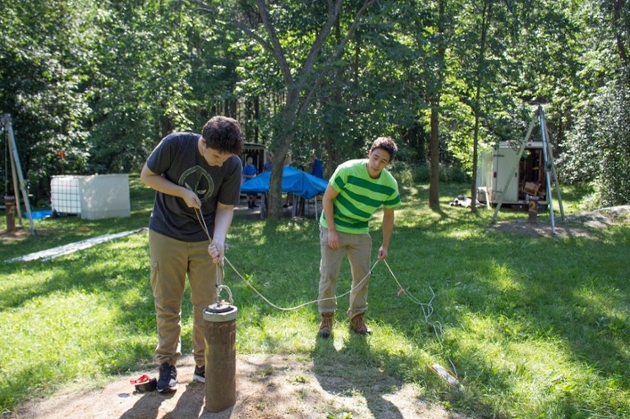
Dr. Novakowski and his graduate students conduct research in the areas of fluid flow and contaminant migration in fractured rock. Recent work has focused on the field measurement and numerical simulation of aqueous phase contaminant transport in large discrete fractures which pervade the dolostones and limestones common to the sedimentary basins of North America. Dr. Novakowski also develops semi-analytical and analytical-element models for the simulation of solute transport, the interpretation of hydraulic tests, and the design of capture zones in sparsely-fractured bedrock. Recently, Dr. Novakowski has become involved in collaborative research projects that are focused on understanding sustainable water supply and regional groundwater flow in complex fractured rock environments.
Dr. Alireza Bakhshai is an Associate Professor in the Department of Electrical and Computer Engineering and is a member of the Interim Advisory Board for the Queen's Centre for Energy and Power Electronics Research (ePOWER). His areas of research interest include high power electronics and applications, renewable energy conversion, and control systems. In addition, he has demonstrated his ability to apply his knowledge in an industrial context, contributing to the application of FACTS Controllers and of New Motor Drive Technologies for a Cold Rolling Mill at the Mobarakeh Steel Company in Iran.
Dr. Jackson Crane is an Assistant Professor in the Department of Mechanical and Materials Engineering. He is interested in renewable energy conversion technologies, electrocatalysis, and low-carbon combustion. His current research focuses on detonation fundamentals with application to high-efficiency engines. He is also active in the area of alternative fuel synthesis via CO2-reduction electrocatalysis.
Dr. Qian Zhang is an Assistant Professor in the Robert M. Buchan Department of Mining at Queen's University in Canada. He leads a research group fostering a roadmap of green mining in Canada and internationally through strategic management of sustainability and resilience challenges in the mining value chain. Dr. Zhang's main research interests are climate change mitigation, environmental and natural resource management, and urban sustainability. His research focuses on greenhouse gas (GHG) accounting, carbon footprint analysis, and policy-oriented modelling of other environmental pressures (natural resource depletion, water scarcity, air pollution, solid waste, etc.) on the built environment using analytical tools, such as input-output analysis, material flow analysis, and life-cycle assessment.
Dr. Warren Mabee is an Assistant Professor in the School of Policy Studies and holds a joint appointment with the Department of Geography. He is the Director of the Queen's Institute for Energy and Environmental Policy (QIEEP) and is the Associate Director of the Sustainable Bioeconomy Centre (SBC). His research focuses on the interface between renewable energy policy and technologies, with particular emphasis on wood energy and biofuels. His interests also include environmental policy, international approaches to renewable energy development, and commercialization of new products and processes. In particular, he is interested in improving the uptake of new energy technologies, examining policy to support for renewable energy options, and the development of strategies to reduce our reliance upon fossil energy sources.
Dr. Gema Olivo is a Professor in the Department of Geological Science and Geological Engineering. As a mineral deposit geologist, her main research interest is to understand processes involved in the genesis of hydrothermal ore deposits, particularly precious metal deposits using a multidisciplinary approach. This involves integrating detailed mapping, petrographic, mineral chemistry, isotopic and fluid inclusion studies, whole-rock geochemistry, and ore and alteration mineral stability investigations. Understanding of these processes will allow for developing more refined genetic models, which will lead to better exploration strategies, improving the odds of success for global mineral exploration.
Full-time students are encouraged to seek external financial support and are encouraged to apply for NSERC and OGS graduate scholarships. Fellowships and teaching assistantships are available through the university and are automatically considered upon admission.